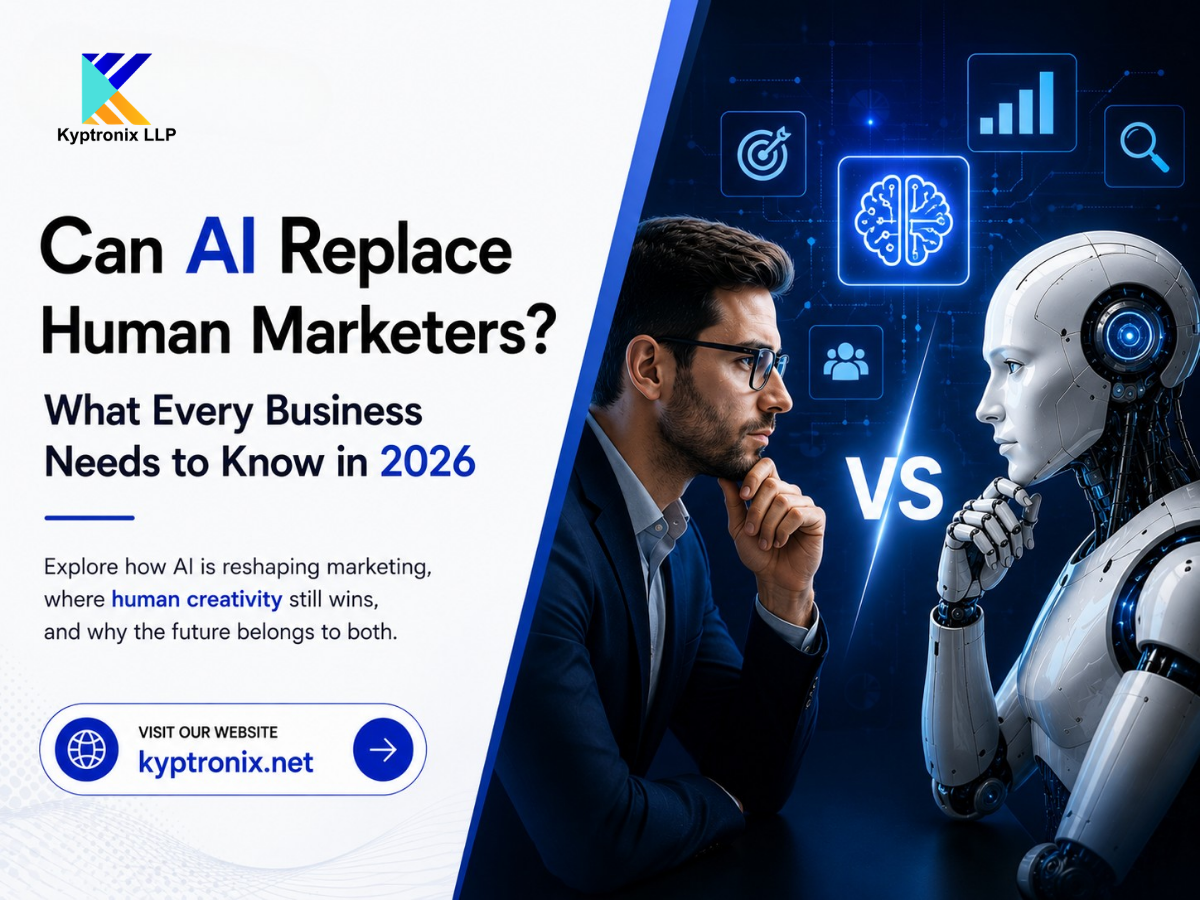
Can AI Replace Human Marketers? What Every Business Needs to Know in 2026
AI Is Changing Marketing Faster Than Ever-But Is It Ready to Take Over?
Artificial Intelligence has transformed the way businesses approach marketing. From generating blog posts and social media content to analyzing customer behavior and automating campaigns, AI is helping brands work faster, smarter, and more efficiently than ever before.
As this technology continues to evolve, many business owners and marketing professionals are asking the same question: Can AI replace human marketers?
The answer isn't as straightforward as a simple yes or no. While AI excels at processing data, automating repetitive tasks, and improving productivity, successful marketing has always been about more than speed and efficiency. It's about understanding people, building trust, telling compelling stories, and creating meaningful connections that inspire action.
At Kyptronix, we believe Artificial Intelligence is changing the way marketing teams work-not replacing them. The businesses achieving the greatest success are those that combine AI-driven efficiency with human creativity, strategic thinking, and industry expertise.
In this guide, we'll explore what AI does exceptionally well, where human marketers continue to have the advantage, and why a balanced approach is shaping the future of digital marketing.
Why AI Is Transforming Digital Marketing
Artificial Intelligence is no longer a futuristic technology reserved for large enterprises.
It's already part of our everyday lives.
Every time Netflix recommends your next series, Spotify creates a personalized playlist, Amazon suggests products based on your browsing history, or Google predicts what you're searching for, AI is working behind the scenes.
Marketing has experienced the same transformation.
Businesses now use AI in digital marketing to automate repetitive tasks, personalize customer experiences, and analyze massive amounts of data that would take humans days-or even weeks-to process manually.
Some of the most common applications of AI in digital marketing include:
- ✓Creating first drafts for blog posts and articles
- ✓Writing email marketing campaigns
- ✓Generating social media content
- ✓Conducting keyword research for SEO
- ✓Personalizing customer experiences
- ✓Automating lead nurturing
- ✓Predicting customer behavior
- ✓Optimizing paid advertising campaigns
- ✓Analyzing website performance
- ✓Producing marketing reports
These capabilities help businesses save time and make data-driven decisions more efficiently.
However, speed alone doesn't guarantee successful marketing.
The real challenge lies in knowing how and when to use AI effectively.
What AI Does Better Than Human Marketers
AI has earned its place in modern marketing because it excels at tasks that require speed, consistency, and large-scale data processing.
Let's explore where AI truly shines.
1. Processing Massive Amounts of Data
Modern marketing generates an overwhelming amount of information: website traffic, search rankings, customer behavior, advertising performance, email engagement, and social media interactions.
For a human, analyzing all of this manually would be incredibly time-consuming.
AI can process millions of data points in seconds, identify patterns, and uncover insights that help businesses make smarter decisions faster. This allows marketers to focus less on spreadsheets and more on strategy.
2. Creating Content Faster
One of AI's biggest strengths is speed. Whether it's generating blog outlines, writing product descriptions, suggesting headlines, or creating social media captions, AI significantly reduces the time required to produce marketing content.
Instead of starting with a blank page, marketers can begin with AI-generated drafts and refine them to match their brand voice. This doesn't eliminate the need for human writers-it simply makes the creative process more efficient.
3. Personalizing Customer Experiences
Today's customers expect brands to understand their needs. AI helps businesses deliver personalized experiences by analyzing browsing behavior, purchase history, demographics, and customer preferences.
As a result, businesses can recommend relevant products, personalize email campaigns, display tailored website content, improve customer engagement, and increase conversion opportunities. This level of personalization would be nearly impossible to manage manually across thousands of customers.
4. Automating Repetitive Tasks
Marketing involves many repetitive activities that consume valuable time. AI can automate processes such as email scheduling, lead scoring, customer segmentation, social media scheduling, campaign reporting, keyword clustering, basic customer support, and workflow automation.
By removing repetitive work, AI gives marketing teams more time to focus on creativity and strategic planning.
5. Improving Marketing Decisions with Predictive Analytics
Instead of relying on guesswork, businesses can use AI to make informed decisions based on historical and real-time data. Predictive analytics helps marketers answer questions like:
- ✓Which leads are most likely to convert?
- ✓What products will customers buy next?
- ✓Which marketing channels deliver the best engagement?
- ✓When should campaigns be launched?
- ✓Which audience segments are most valuable?
This allows businesses to allocate resources more effectively and improve campaign performance.
Where Human Marketers Continue to Lead
Despite AI's impressive capabilities, there are areas where technology simply cannot replace human expertise.
Marketing isn't just about efficiency. It's about understanding people, emotion, and creating experiences that customers remember.
These are qualities that still belong to human marketers.
Emotional Intelligence
People don't buy products based solely on logic. They buy because they feel understood. Whether it's trust, excitement, curiosity, or inspiration, emotions influence purchasing decisions far more than most businesses realize.
Human marketers understand cultural nuances, customer frustrations, aspirations, and motivations in ways AI simply cannot. They know when to inspire, when to reassure, and when to challenge conventional thinking. That's why the most memorable campaigns often connect emotionally rather than intellectually.
Storytelling That Builds Brands
AI can write paragraphs. Humans build stories. Every successful brand has a story that reflects its values, mission, and personality. Great storytelling transforms ordinary businesses into memorable brands.
Think about the companies you admire most. People rarely remember feature lists; they remember stories. Human marketers understand how to weave narratives that resonate with audiences and create lasting emotional connections. AI can assist with writing, but it cannot genuinely create authentic brand experiences rooted in human understanding.
Creative Thinking
Marketing isn't simply following templates. It's about finding fresh ideas that capture attention in crowded markets. Creativity involves experimentation, intuition, and imagination-qualities that cannot be fully automated.
Some of the world's most successful campaigns succeeded because someone challenged the obvious solution and took a creative risk. AI learns from existing patterns; humans create entirely new ones.
Strategic Decision-Making
Every business has different goals, audiences, competitors, and challenges. Marketing strategies must consider all of these factors.
Human marketers evaluate changing market conditions, customer feedback, competitive landscapes, and long-term business objectives before making strategic decisions. AI provides recommendations; humans decide which direction is best.
Building Relationships That AI Can't
Marketing has always been about people connecting with people. While AI can analyze customer behavior and automate responses, it cannot build genuine relationships based on trust, empathy, and shared experiences.
Think about the brands you return to time and again. Chances are, it's not because they sent the most emails or published the most content. It's because they consistently delivered value, communicated authentically, and made you feel understood. Human marketers are responsible for creating those connections. They collaborate with customers, partners, influencers, and communities to strengthen a brand's reputation over time.
This human element is especially important during moments that require empathy, such as responding to customer concerns, managing brand reputation, or communicating during a crisis.
AI vs Human Marketing: A Side-by-Side Comparison
The question isn't whether AI is better than humans or vice versa. Both bring unique strengths to modern marketing.
| AI Marketing | Human Marketing |
|---|---|
| Processes large volumes of data quickly | Understands emotions and human behavior |
| Automates repetitive tasks | Develops long-term marketing strategies |
| Creates first drafts rapidly | Crafts compelling brand stories |
| Personalizes campaigns using data | Builds authentic customer relationships |
| Identifies trends and patterns | Thinks creatively and solves unique challenges |
| Optimizes campaigns continuously | Makes ethical and business-focused decisions |
| Works 24/7 without fatigue | Adapts to changing market situations |
The businesses seeing the greatest success today aren't replacing their marketing teams with AI. They're empowering those teams with AI.
The Biggest Limitations of AI in Marketing
AI has transformed how marketing teams work, but it's far from perfect. Understanding its limitations helps businesses use it more effectively.
It Lacks Genuine Creativity
AI generates content by identifying patterns in existing information. It doesn't imagine entirely new ideas or draw from personal experiences. That means AI can help you write a campaign, but it can't invent a groundbreaking brand story that truly sets your business apart.
It Doesn't Understand Human Emotions
AI can recognize sentiment based on data, but it doesn't experience emotion. It doesn't understand the excitement of launching a new business, the frustration of losing customers, or the confidence a well-crafted campaign can inspire. Human marketers use emotional intelligence to communicate with empathy and authenticity.
It Can Produce Inaccurate Information
Generative AI occasionally creates content that sounds convincing but contains factual errors or outdated information. Without human review, businesses risk publishing misleading information that can damage credibility and customer trust. This is why every AI-generated asset should be reviewed before publication.
Brand Voice Still Needs Human Direction
Every successful brand has a distinct personality. Some are formal and authoritative; others are friendly and conversational. While AI can imitate different writing styles, maintaining a consistent brand voice across every touchpoint still requires human oversight. A skilled marketer ensures that every piece of content reflects the company's identity and values.
Marketing Is About More Than Algorithms
Successful campaigns often rely on timing, intuition, cultural awareness, and understanding what matters to people in a particular moment. These qualities can't be measured entirely through data. AI provides valuable insights, but humans provide context.
Why Hybrid Marketing Is the Future
The future of marketing isn't AI versus humans. It's AI working alongside humans.
Businesses that combine technology with human expertise can move faster, make smarter decisions, and create more meaningful customer experiences.
A hybrid approach allows AI to handle repetitive and data-intensive tasks while marketers focus on areas where human judgment makes the biggest difference.
Let AI Handle:
- • Keyword research
- • SEO analysis
- • Marketing automation
- • Customer segmentation
- • Campaign reporting
- • Data analysis
- • Performance monitoring
- • Draft content creation
Let Human Marketers Handle:
- • Brand strategy
- • Creative campaigns
- • Storytelling
- • Customer relationships
- • Final content editing
- • Decision-making
- • Market positioning
- • Business growth planning
By combining both strengths, businesses can improve efficiency without sacrificing creativity or authenticity.
How Kyptronix Helps Businesses Embrace AI-Powered Marketing
At Kyptronix, we believe AI should enhance marketing, not replace the people behind it.
Our approach combines advanced technology with strategic expertise to help businesses achieve sustainable growth. We help organizations integrate AI into their marketing workflows while ensuring every campaign remains aligned with their goals, audience, and brand identity.
Our services include:
Whether you're looking to improve lead generation, automate repetitive tasks, strengthen your online presence, or develop a long-term digital strategy, Kyptronix provides practical solutions tailored to your business.
Ready to combine the speed of AI with the creativity of human expertise? Partner with Kyptronix to build smarter marketing strategies that drive lasting business growth.
What Does the Future of Marketing Look Like?
Artificial Intelligence will continue to evolve, but marketing will always depend on understanding people.
Over the next few years, businesses can expect to see:
- ✓More advanced AI assistants supporting marketing teams
- ✓Greater personalization across digital experiences
- ✓Smarter predictive analytics for campaign planning
- ✓Increased use of AI in customer service
- ✓Enhanced marketing automation
- ✓Stronger focus on responsible and ethical AI
- ✓Greater demand for human creativity and strategic thinking
As technology becomes more accessible, the competitive advantage won't come from simply using AI. It will come from knowing how to use AI wisely.
Conclusion
So, can AI replace human marketers? Not completely.
AI is exceptional at processing data, automating workflows, generating ideas, and improving efficiency. It enables marketing teams to work faster and make more informed decisions.
However, marketing is fundamentally about people. It requires creativity, empathy, critical thinking, and the ability to build genuine relationships-qualities that remain uniquely human.
The most successful businesses aren't choosing between AI and human marketers. They're combining both to create marketing strategies that are efficient, authentic, and focused on long-term growth.
At Kyptronix, we help businesses harness the power of AI while preserving the creativity and strategic thinking that build trusted brands. By blending intelligent technology with human expertise, we help organizations navigate the future of digital marketing with confidence.