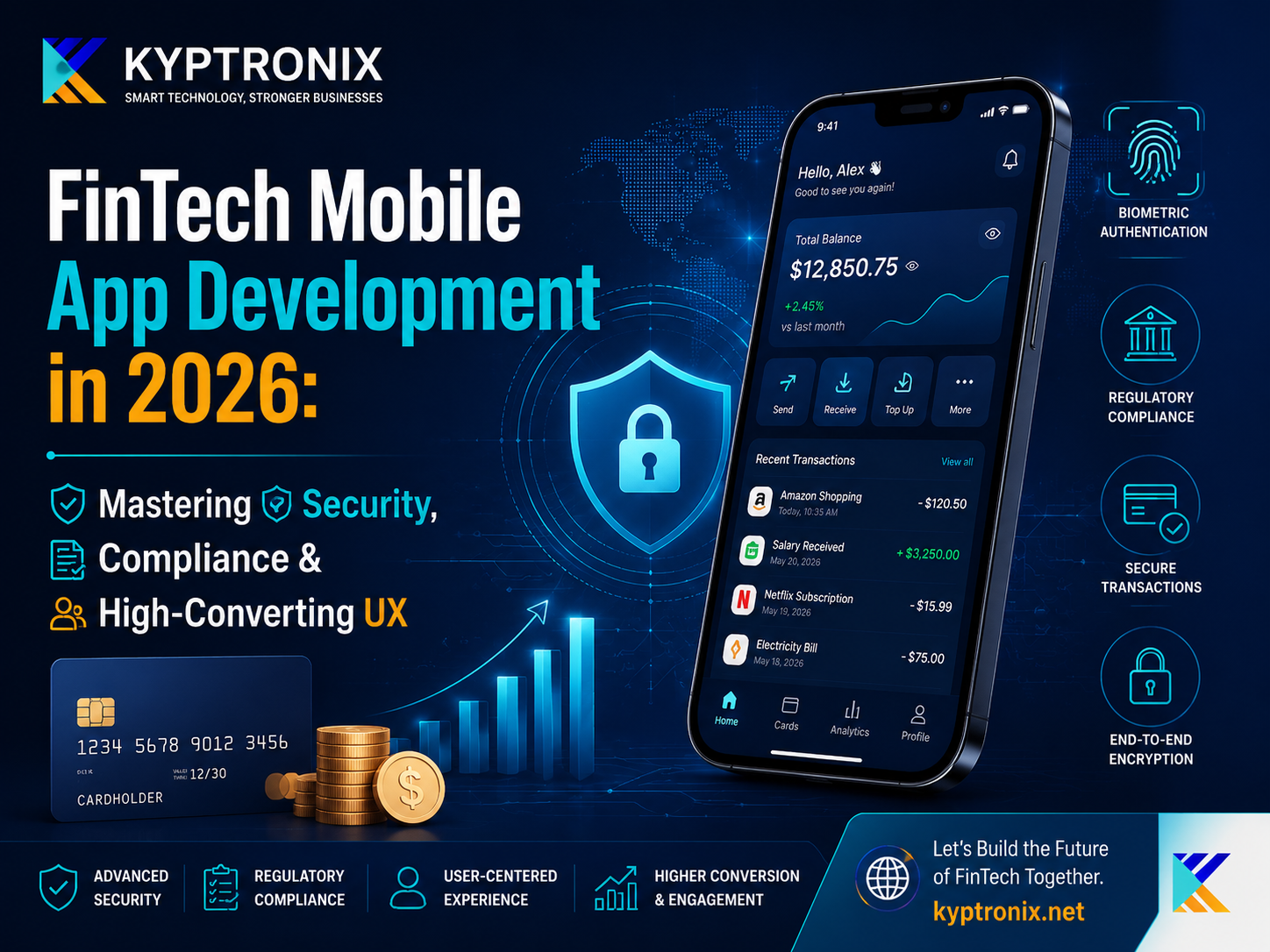
FinTech Mobile App Development in 2026: Mastering Security, Compliance & High-Converting UX
Suppose opening a mobile app to transfer $10,000 across international borders. You expect the transaction to clear in seconds, the interface to look as clean as a luxury consumer app, and the underlying system to be as impenetrable as Fort Knox. If the app freezes for two seconds during authentication, you get nervous. If it requires four different complex password screens, you get frustrated and close the app.
This is the central dilemma facing the financial technology sector today: How do you build a mobile application that is simultaneously unhackable, strictly compliant with global regulators, and so effortless to use that customers open it every day?
The financial tech market has expanded exponentially. Recent industry forecasts indicate that the mobile applications segment accounts for over 58% of the global FinTech market value, with total mobile application transaction volumes exceeding trillions of dollars annually. From internet-only banking and peer-to-peer (P2P) payments to algorithmic stock trading and decentralized crypto wallets, consumers no longer view mobile apps as a convenience channel; they view them as their primary bank branch.
However, building software for the financial sector is fundamentally different from building a retail or social media platform. A bug in an e-commerce cart results in an abandoned checkout. A security flaw or compliance oversight in a payment app can lead to multi-million-dollar regulatory fines, stolen user funds, and permanent brand destruction.
Achieving sustainable commercial success requires a holistic approach to FinTech Mobile App Development, one that treats robust FinTech app security, rigid PCI DSS 4.0 compliance, and intuitive financial app UX design not as competing priorities, but as mutually reinforcing engines of growth.
The FinTech Triad: Balancing Security, Compliance, and User Experience
In early digital banking, software teams operated under the assumption that security and user convenience existed on a rigid zero-sum spectrum, i.e., if you make an app more secure, you inevitably make it harder to use.
In 2026, that assumption is dead. Modern financial engineering utilizes contextual data, machine learning threat analysis, and hardware-level cryptography to deliver hyper-secure experiences that feel virtually weightless to the user.
To understand how these three pillars interact inside a commercial application, take a look at this structural comparison matrix:
| Architectural Pillar | Core Objective | Business & User Impact | Technical Overhead & Requirements |
|---|---|---|---|
| FinTech App Security | Defend application runtime, user credentials, and financial APIs against cyber threats | Establishes brand trust, eliminates breach liability, and protects customer funds | High (Requires a zero trust architecture, end-to-end encryption, and RASP) |
| Regulatory Compliance | Align system operations with regional and global financial laws | Prevents legal shutdown, eliminates regulatory fines, and enables market expansion | High (Requires PCI DSS 4.0 compliance, KYC AML verification, and audit logs) |
| Financial UX Design | Reduce cognitive friction, clarify complex money flows, and drive user engagement | Boosts 30-day user retention, increases transaction velocity, and lowers support tickets | Moderate to High (Demands biometrics, progressive disclosure, and WCAG accessibility) |
Pillar 1: Uncompromising FinTech App Security (The Engineering Foundation)
When users trust an application with their hard-earned money, security is not a feature; it is the baseline condition of existence. Financial applications face sophisticated attack vectors daily, including automated credential stuffing, man-in-the-middle (MitM) network sniffing, reverse engineering, and SIM swapping.
Executing modern FinTech Mobile App Development requires adopting a strict zero trust architecture. In a zero-trust model, the application never assumes that the local device environment, the network connection, or even a previously authenticated user session is inherently safe. Every single API call and data transaction is continuously verified in real time.
Essential Security Safeguards for Modern Financial Software
- Hardware-Backed Cryptography: Sensitive keys and session tokens should never reside in standard software memory. Top-tier apps store cryptographic keys inside native hardware security modules, such as Apple's Secure Enclave or Android's StrongBox.
- Dynamic Biometric Authentication: Implementing native biometric authentication in FinTech, such as Face ID, fingerprint scanning, or iris recognition, allows users to bypass clunky text passwords while raising the security bar. Modern apps combine biometrics with contextual risk scoring (evaluating device location, IP reputational flags, and behavioral typing cadence) to trigger step-up Multi-Factor Authentication (MFA) only when suspicious anomalies occur.
- Runtime Application Self-Protection (RASP): Financial mobile binaries must defend themselves in hostile device environments. RASP tools detect if an app is running on a rooted or jailbroken device, identify active code injection attempts, block emulator hooks, and shut down sessions automatically if a debugger is detected.
- End-to-End Encryption in Transit and at Rest: All cardholder data, account numbers, and personal details must be encrypted using AES-256 standards at rest and protected by TLS 1.3 with strict certificate pinning in transit, preventing attackers from intercepting network packets over public Wi-Fi networks.
Pillar 2: Navigating Regulatory Compliance & Legal Frameworks
Building a financial application means operating inside one of the most heavily regulated industries on earth. Navigating compliance is not a one-time checklist executed before launch; it is an ongoing operational commitment.
- Payments & Cards: PCI DSS 4.0 / 4.0.1 Mandatory Mandates
- Identity & Fraud: KYC / AML Automated Liveness & Sanctions Checks
- Data Exchange: Open Banking APIs (PSD2 / PSD3 / FAPI Standards)
- Consumer Privacy: GDPR, CCPA, and Regional Data Sovereignty Laws
1. Mastering PCI DSS 4.0 Compliance
If your application processes, transmits, or stores credit or debit card data, adhering to the Payment Card Industry Data Security Standard is non-negotiable. The mandatory rollout of PCI DSS 4.0 compliance has fundamentally raised the technical bar for app developers:
- Mandatory Multi-Factor Authentication (MFA) for all access into the Cardholder Data Environment (CDE).
- Continuous automated monitoring and protection against web skimming and unauthorized JavaScript modifications.
- Upgraded cryptographic requirements that mandate file-level encryption, cryptographically keyed hashes, and automated SIEM security logging.
2. Automated KYC AML Verification Pipelines
Financial anti-money laundering laws require apps to verify user identities explicitly before unlocking financial transactions. Incorporating a modern KYC AML verification pipeline directly into your onboarding flow is crucial to prevent fraudulent account creation without creating massive drop-off rates:
- AI Liveness Detection: Users snap a selfie while an AI model checks for micro-expressions and 3D depth to ensure a real human is present, preventing spoofing via photos or deepfake videos.
- OCR Document Processing: Automated optical character recognition extracts details from passports or driver's licenses instantly, matching them against government databases.
- Real-Time Sanctions & PEP Screening: Background systems automatically check user names against global Politically Exposed Persons (PEP) and international sanctions registries before granting access.
3. Open Banking API Integration
The global shift toward open finance allows users to securely connect their bank accounts to third-party budgeting, lending, and investment apps. Executing an Open Banking API integration requires leveraging standardized, highly secure protocols such as the Financial-grade API (FAPI) security profile built on top of OAuth 2.0 and OpenID Connect. This ensures users can share financial telemetry with your app without ever handing over their primary banking credentials.
Compliance Checklist for FinTech Development Teams
To help your team navigate these complex regulatory mandates without missing critical deadlines, follow this structured execution roadmap:
- 1. Map Cardholder Data Environments & Regulatory Scope (Phase 1: Architecture & Data Mapping): Document every single data pipeline where financial assets, account numbers, or personal details flow. Define your exact compliance scope to minimize operational audit overhead under PCI DSS 4.0 compliance mandates.
- 2. Deploy Hardware-Backed MFA & KYC Engines (Phase 2: Authentication & Identity): Integrate native biometric authentication in FinTech applications paired with automated KYC AML verification APIs to verify user identity instantly upon registration.
- 3. Enforce TLS 1.3, Certificate Pinning & Keyed Hashes (Phase 3: Encryption & Transport Security): Configure AES-256 database-level encryption for static data assets and enforce TLS 1.3 with strict certificate pinning for all API endpoints to prevent network interception.
- 4. Implement FAPI-Compliant Open Banking Connectors (Phase 4: Open Architecture & API Defense): Build secure Open Banking API integration pipelines using OAuth 2.0 and FAPI standards, ensuring third-party financial data exchange remains fully sandboxed.
- 5. Establish SIEM Logging & Routine Penetration Sprints (Phase 5: Continuous Auditing & Maintenance): Set up automated SIEM event monitoring systems to detect unauthorized access attempts instantly, and schedule recurring FinTech app maintenance cycles to deploy emergency security patches.
Pillar 3: Designing Frictionless Financial UX (Humanizing Finance)
An application can be completely impenetrable and fully certified by regulators, but if users find the visual layout confusing or intimidating, they will delete it and move to a competitor. Superior financial app UX design is the ultimate differentiator in an overcrowded digital market.
When users deal with money, they experience subconscious anxiety. Every visual element, color choice, and micro-animation inside your interface should work to alleviate that stress, build emotional confidence, and clarify financial outcomes.
Design Principles That Drive High-Converting FinTech Interfaces
- Progressive Onboarding Disclosure: Don't force users to complete a 15-step identity verification process the second they download your app. Allow them to explore basic features first, introducing KYC AML verification step-by-step only when they initiate an action that legally requires identity checks.
- Visual Data Clarity: Replace endless rows of dense spreadsheet numbers with clean, interactive visual data visualizations. Color-coded spending category wheels, trend lines, and goal trackers make complex financial data easy to understand at a glance.
- Humanizing Error States: Standard software error messages like "Error 502: Bad Gateway" cause panic in financial apps. Instead, design clear, reassuring error screens, such as "We couldn't process that transfer right now, but don't worry, your funds are safe in your account. Let's try again."
- Deliberate Friction (Confirmation Velocity): While general software design strives to eliminate all user friction, financial UX occasionally requires intentional friction. Adding a slide-to-confirm gesture before executing an irreversible $5,000 wire transfer prevents accidental taps and gives users a sense of total control.
The Step-by-Step Blueprint: Building a Commercial FinTech App
Bringing a production-grade financial mobile platform to market requires a disciplined software engineering process. Here is how leading technical teams execute the lifecycle:
- Phase 1: Discovery & Regulatory Scoping: Define core user personas, map business revenue models, and audit regional compliance rules (PCI-DSS, GDPR, SOC 2 Type II).
- Phase 2: Threat Modeling & Security Architecture: Establish zero trust architecture rules, design database schemas with hardware encryption, and configure FAPI API gateways.
- Phase 3: Interactive Prototyping & UX Sprinting: Design high-fidelity wireframes using financial app UX design principles, running usability tests with real users to eliminate navigation bottlenecks.
- Phase 4: Agile Full-Stack Engineering: Write clean frontend and backend code in 2-week agile sprints, integrating biometric authentication in FinTech features alongside Open Banking API integration modules.
- Phase 5: QA, Penetration Testing & Compliance Auditing: Subject the candidate build to rigorous static code analysis, third-party vulnerability penetration tests, and formal compliance certification.
- Phase 6: Deployment & Continuous Maintenance: Launch on the digital storefronts while establishing automated monitoring for SIEM event logs and scheduling recurring FinTech app maintenance updates.
Conclusion: Partnering with Kyptronix for FinTech Innovation
The future of global finance is entirely mobile, instant, and personalized. However, building a successful application inside this high-stakes ecosystem requires balancing military-grade FinTech app security, rigid regulatory compliance, and delightful, high-converting user interfaces.
Succeeding in FinTech Mobile App Development demands a technology partner who understands the deep technical architectures of modern financial systems.
At Kyptronix, we specialize in transforming complex financial workflows into secure, high-performing mobile platforms. We don't just write code; we partner closely with neobanks, payment processors, investment platforms, and InsurTech innovators to build software that scales safely. Whether you need to execute a complex Open Banking API integration, achieve full PCI DSS 4.0 compliance, integrate smooth biometric authentication in FinTech workflows, or redesign your app's core user experience, our team brings the technical skill and regulatory knowledge required to win in today's market.
Ready to engineer a world-class financial application that your users will trust and love? Connect with the FinTech engineering team at Kyptronix.net today to schedule your comprehensive technical consultation.
Frequently Asked Questions (FAQs)
Financial mobile development operates under strict regulatory scrutiny and faces extreme security threat levels. Unlike general utility or retail apps, financial platforms must incorporate mandatory data encryption standards (AES-256), enforce multi-factor biometric authentication, integrate real-time identity checks (KYC/AML verification), and achieve formal regulatory compliance, such as PCI DSS 4.0, to protect customer funds.
PCI DSS 4.0 compliance introduces strict technical mandates for any mobile app handling cardholder data. It requires mandatory Multi-Factor Authentication (MFA) for all access into the cardholder data environment, protection against unauthorized client-side JavaScript changes, file-level encryption, cryptographically keyed hashes, and automated SIEM security logging.
A zero trust architecture operates under the principle of "never trust, always verify." Instead of assuming that an authenticated device or internal network is safe, the system continuously verifies every single API call, user request, and network connection in real time using biometric tokens and contextual threat scoring.
To minimize onboarding drop-off, apply principles of progressive disclosure. Allow new users to explore basic app features before requesting identity documents, use AI-powered liveness detection and optical character recognition (OCR) to auto-fill form fields from photo IDs, and provide instant visual feedback if an uploaded document is blurry.
An Open Banking API integration allows your app to securely connect to a user's existing bank accounts, enabling real-time account aggregation, instant transaction categorization, automated loan scoring, and direct account-to-account payments using standardized, highly secure FAPI protocols without exposing primary online banking passwords.
While most software design aims to make actions as fast as possible, financial transactions benefit from deliberate friction, such as a slide-to-confirm slider or biometric step-up modal, before completing high-value or irreversible money transfers. This prevents accidental taps, reduces user panic, and gives customers absolute confidence in the safety of their funds.
Financial applications should undergo automated vulnerability scanning continuously, alongside comprehensive, third-party ethical hacking penetration tests at least twice a year or immediately whenever a major technical update is made to the app's core payment or authentication infrastructure.
RASP tools operate directly inside the mobile app binary to defend it in hostile environments. RASP detects if a smartphone is rooted or jailbroken, blocks code injection attacks, prevents reverse engineering tools from inspecting source code, and terminates the active session if a malicious process is detected.
Ongoing FinTech app maintenance includes deploying emergency security patches, updating dependencies to maintain compatibility with annual iOS and Android operating system upgrades, auditing compliance logs, updating third-party KYC/AML API connectors, and scaling cloud server infrastructure to handle rising transaction volumes.
Yes. Modern cross-platform frameworks like Flutter and React Native are widely used to build enterprise-grade financial software. They allow engineering teams to write a single codebase that deploys across both iOS and Android simultaneously, cutting development costs by up to 40% while supporting hardware-backed encryption, native biometrics, and full regulatory compliance.