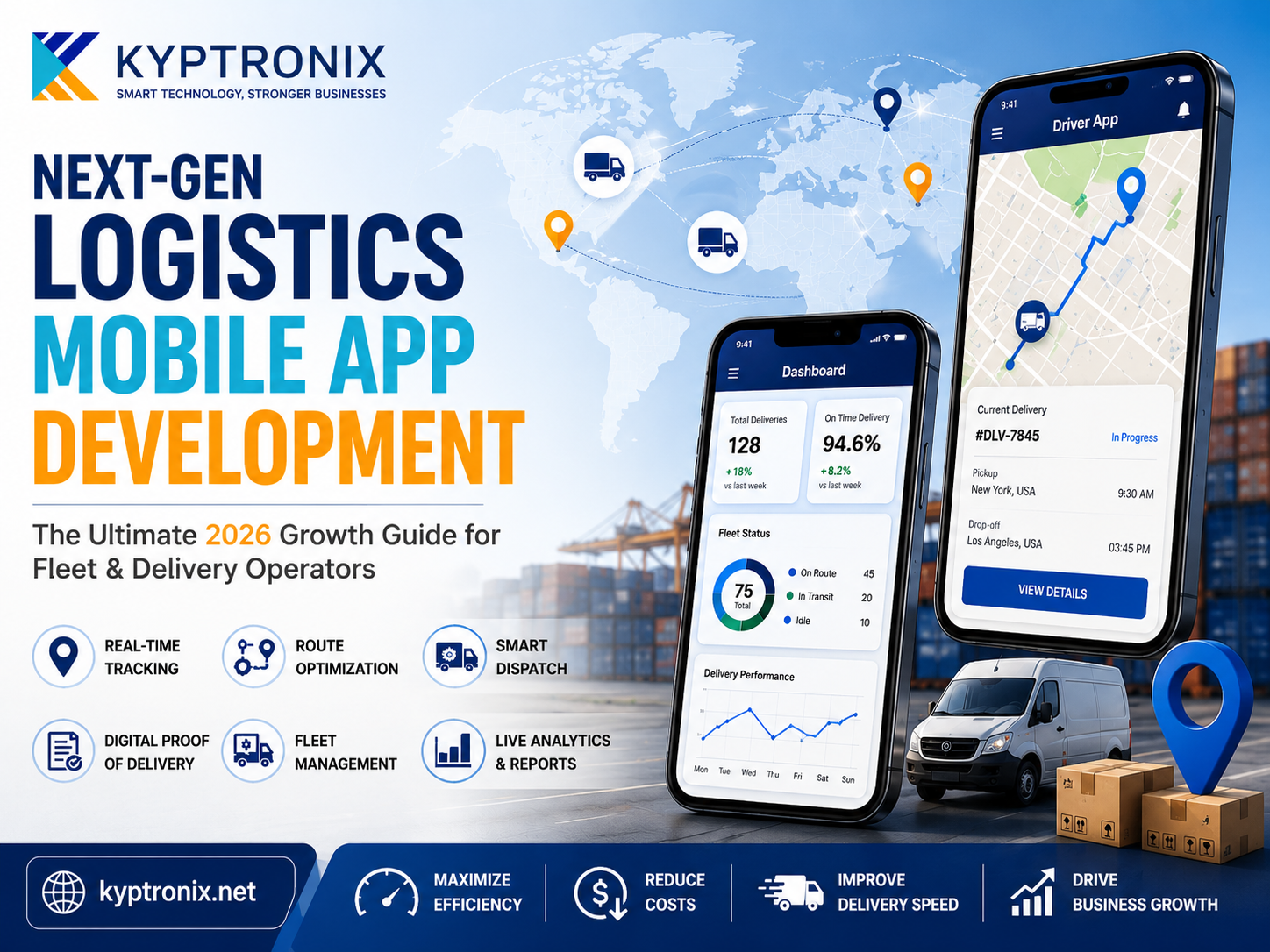
Next-Gen Logistics Mobile App Development: The Ultimate 2026 Growth Guide for Fleet & Delivery Operators
Running a fleet or logistics company comes with its share of challenges. Between fluctuating fuel prices, strict delivery timelines, staffing shortages, and customer demands for shippable inventory transparency, using conventional tools for tracking and managing multi-leg distribution routes can be a costly exercise. With the worldwide e-commerce market valued at 7,650 billion dollars, carriers are seeing a spike in orders requiring physical delivery. The digital logistics market is projected to reach 155 billion plus by 2027 as carriers scramble to satisfy the demand for tracking and automating their multi-leg delivery processes.
In 2026, it is no longer optional. It is a business imperative for freight managers to adopt mobile applications. Whether you run a local courier service or a long-haul freight shipping company, logistics mobile apps will give you maximum control over your operations.
This guide covers everything about logistics mobile apps, including:
- The 3-part tech stack of logistics app development,
- How to choose between custom logistics mobile app development and SaaS logistics platforms,
- The 5 high ROI features every fleet owner should consider,
- How much a logistics mobile app costs, and much more.
Understanding The 3 Software Stacks That Make Up Logistics Mobile Apps
One of the most common misconceptions about developing a logistics application is that it is a standalone piece of software that can be downloaded from an app store. In reality, modern supply chain app management entails a three-way software system where the cloud ERP backend serves as the connective tissue:
1. The Driver Mobile Application
The driver application serves as a turn-by-turn navigation tool while also offering features such as barcode scanning and electronic proof of delivery. It aims to reduce distractions to give the driver full attention to the road.
2. The Dispatch/Web Portal
The web portal serves as the nerve center where dispatchers monitor the overall progress of deliveries, track driver progress, and assign new jobs based on proximity, vehicle type, and driver availability.
3. The Customer App
Every logistics company, whether it serves B2B or B2C clients, should consider developing a tracking application where customers can monitor the status of their deliveries in real-time.
Custom Logistics Software Development vs Off-the-Shelf SaaS: What To Choose?
When it comes to digitizing transport operations, one of the first choices that confront each business owner is whether to go with a SaaS logistics platform or invest in custom logistics app development. While it is easy to sign up for a monthly subscription plan when starting with just a few vehicles, large-scale logistics companies tend to max out their budgets since proprietary SaaS logistics software is not designed to scale. The table below compares some of the critical differences:
| Operational Dimension | Custom Logistics Mobile Apps | Off-the-Shelf SaaS Platforms |
|---|---|---|
| Feature Customization | 100% tailored to your specific dispatch rules, workflows, and cargo types | Rigid, pre-built feature sets that force you to adapt your operations to the software |
| System Interoperability | Native, deep logistics ERP integration with legacy SAP, Oracle, WMS, and accounting tools | Dependent on basic pre-built webhooks or limited API connectors |
| Long-Term TCO | Higher upfront investment, but zero monthly per-driver or per-vehicle subscription licensing fees | Low initial cost, but rapidly escalating monthly seat/vehicle subscription fees that drain margins as you scale |
| Data Security & Ownership | You retain 100% ownership of your proprietary route data, customer records, and source code | Customer and operational telemetry resides on third-party multi-tenant cloud servers |
| Competitive Differentiation | Proprietary algorithms provide unique routing, pricing, and service speed advantages | Identical feature set used by your direct market competitors |
What To Do If You Want To Make Your Own Delivery App For Transportation Business
To save time and money when developing a logistics mobile application, focus on high-impact features that will ensure faster ROI on your development budget. Below are the 5 most important features every logistics application should have:
1. Real-Time GPS Tracking With Background Status Updates
Using a reliable real-time GPS tracking software is a must for long-haul transportation companies because it ensures maximum visibility of the delivery process. Combined with automated geofencing, GPS tracking helps update the delivery status as soon as a vehicle arrives at the destination without requiring any input from the driver.
2. AI Route Optimization To Reduce Fuel Consumption
Fuel costs account for nearly 30% of all costs incurred by a transportation company, which means that any feature that promises to reduce fuel consumption by even 5% is worth considering. When developing a logistics application, consider integrating a route optimization API that will automatically calculate the shortest driving routes based on traffic, roadwork, and vehicle weight. According to research, using AI for route planning can eliminate up to 20% of total fuel spent while also improving on-time delivery rates.
3. Electronic Proof of Delivery To Eliminate Paperwork
Using paper-based delivery receipt systems is a recipe for errors since bills and invoices can be misplaced, causing delivery disputes and delayed payments. By integrating proof of delivery software within your logistics mobile application, you can allow your drivers to capture electronic signatures and photos of the delivered items. You can also consider adding barcode scanning and GPS location tracking features to generate a comprehensive digital proof of delivery. The ability to capture electronic proof of delivery can reduce delivery disputes by over 30%.
4. On-demand Dispatching & Freight Matching
Courier companies and third-party logistics providers can benefit from on-demand delivery app development software. This feature allows dispatchers to automatically match available drivers and vehicles with nearby delivery jobs, thus eliminating dead miles.
5. Telematics & Preventive Maintenance Features
By pairing your logistics application with an OBD-II car diagnostic tool, you can give your fleet managers access to real-time vehicle diagnostic information. Additionally, you can use the telematics data to notify mechanics of when a vehicle requires servicing, thus eliminating unanticipated breakdowns.
6. End-to-End ERP & WMS Synchronization
Manually entering every delivery activity within your logistics ERP is a recipe for errors and inefficiency. Ensure seamless synchronization of your logistics application with other business systems such as WMS, accounting, and Blue Yonder.
Implementation Roadmap: How Logistics Mobile Apps Are Built
The most common mistake that causes logistics mobile app development to fail is rushing into development without first understanding how current operations will be improved with digitization. Below is a high-level roadmap of how enterprise logistics applications are developed:
1. Week 1 - 3: Conduct Supply Chain Audit & Scoping
This phase involves working closely with stakeholders to identify improvement areas such as optimizing delivery routes, reducing fuel consumption, and capturing electronic proof of delivery. This phase also includes determining who the end-users will be: long-haul drivers, dispatchers, customers, or installers.
2. Week 4 - 6: Plan The Technical Architecture & ERP Integrations
This phase focuses on technical requirements such as selecting the right cloud database and planning how the logistics ERP will connect with other systems. After completing this stage, you should have a solid technical foundation that will facilitate seamless logistics ERP integration, WMS connection, and delivery route optimization.
3. Week 7 - 12: Create Prototypes & Design High-Impact UI/UX
Most end-users, such as drivers, will spend most of their time within the logistics mobile application. As such, it is paramount to design intuitive mobile interfaces that are easy to navigate. Additionally, you can consider developing prototypes that allow drivers to save delivery data offline before syncing it to the cloud.
4. Week 13 - 22: Develop Application With Agile Methodology
At this point, you will start the actual coding of the mobile application. A good rule to follow when building logistics applications is to use the 2-week agile development cadence.
5. Week 23 - 36: Conduct QA Testing & Fleet Deployment
Once you have a working version of your logistics application, it is time to conduct QA testing. This phase also includes training your drivers on how to use the new system before final deployment.
Deconstructing The True Cost Of Custom Logistics App Development
Most business owners who want to invest in custom logistics software development are often concerned about the bottom line. Below are the most common cost influencers in logistics app development:
1. Number of Applications Being Developed
While it is possible to have a standalone driver mobile application, most logistics companies will require a three-way application that includes a customer tracking app, a web dispatch console, and a driver mobile application. The larger the scope of development, the higher the development costs.
2. Incorporating Telematics & Third-Party APIs
A good logistics application requires the incorporation of third-party APIs such as SMS, GPS services, and payment processors. Working with multiple APIs increases development costs.
3. Advanced Algorithm Logic For Route Optimization
While building the routing logic for a delivery app may seem simple, building advanced AI route optimization engines requires years of algorithmic experience.
How Much Does A Logistics App Cost?
While many logistics managers are still on the fence about investing in logistics software development, the ROI is almost immediate, provided a well-designed logistics application can reduce fuel costs by up to 25%. However, it is essential to understand what determines the cost of a logistics application. Below is a sample budget analysis for a commercial logistics application:
| Application Component | Estimated Budget |
|---|---|
| Web Dispatch Console | $4,000 |
| Driver's Mobile Application | $18,000 |
| Customer Tracking App | $5,000 |
| Telematics & GPS Integration | $10,000 |
| AI Route Optimization API | $21,000 |
| ERP & WMS Synchronization | $9,000 |
The data above shows that the development cost heavily depends on the number of applications being developed. Most logistics managers overlook the importance of developing a dispatch console that offers better control and oversight of all ongoing delivery activities. The other big expense is often incorporating APIs such as AI route optimization engines to automatically calculate the shortest driving routes.
Conclusion: Partnering with Kyptronix for Supply Chain Transformation
The global transport and freight sector is undergoing a rapid, permanent digital transition. Carriers that continue to rely on manual processes, disconnected communication channels, and outdated tracking tools risk being squeezed out by technology-driven competitors who operate faster, leaner, and with absolute transparency.
Investing in tailored logistics mobile app development empowers your organization to take full control of its supply chain operations, reducing fuel waste, improving fleet safety, streamlining dispatch workflows, and delivering the real-time visibility modern shippers demand.
At Kyptronix, we specialize in transforming complex operational challenges into streamlined, high-performing digital platforms. Whether you need to build a comprehensive fleet management mobile app, modernize your last-mile delivery app development stack, or execute a complex logistics ERP integration, our team brings the technical skill and industry knowledge to bring your vision to life.
Ready to eliminate operational friction and scale your transport network? Connect with the software engineering team at Kyptronix.net today to schedule your technical consultation.
Frequently Asked Questions (FAQs)
Developing a custom logistics mobile app development ecosystem takes between 3 and 6 months, depending on project complexity. A streamlined Minimum Viable Product (MVP) focusing on core driver navigation and tracking can launch in 10 to 14 weeks, while a full enterprise suite featuring AI route optimization and deep ERP integrations requires 5 to 8 months.
A fleet management mobile app tracks driver behavior like idle time, hard braking, and speeding, monitors engine health, and automates preventive maintenance scheduling. By optimizing vehicle performance and reducing idle time, fleets regularly cut annual fuel and repair expenses by 15% to 20%.
Yes. Professional logistics applications are engineered using an "offline-first" architecture. Drivers can continue scanning barcodes, capturing delivery signatures, and completing route tasks in remote transport corridors. All logged data is cached locally on the device and syncs with cloud servers automatically once a network connection is re-established.
The total custom logistics software cost depends on the number of distinct user applications required driver app, dispatcher portal, customer interface, the complexity of AI routing algorithms, third-party mapping API usage, local device hardware integrations (barcode scanners or thermal printers), and the scope of legacy ERP/WMS system integrations.
Achieving clean logistics ERP integration eliminates duplicate data entry and manual errors. It ensures that whenever a driver logs a completed delivery on their mobile app, inventory levels, customer billing records, and payroll logs update automatically across enterprise platforms like SAP, Oracle, or QuickBooks.
Last-mile delivery app development gives customers real-time map tracking, precise delivery arrival windows, automated push notifications, and instant digital proof of delivery. This transparency reduces customer support calls by over 40% and builds trust with retail and B2B clients.
The driver app is a mobile-first interface optimized for single-handed use, turn-by-turn navigation, e-signatures, and on-field package scanning. The dispatcher portal is a desktop-optimized web console that gives fleet managers full overview visibility over all active drivers, automated dispatch queues, vehicle telemetry, and route performance analytics.
A modern route optimization app engine simultaneously analyzes traffic congestion patterns, weather reports, vehicle weight limits, historical delivery speeds, and multi-stop delivery priorities. It dynamically recalculates delivery routes in real time to ensure couriers take the fastest, most fuel-efficient path possible.
Enterprise logistics applications protect data by implementing end-to-end encryption (AES-256 at rest, TLS 1.3 in transit), strict Role-Based Access Controls (RBAC), multi-factor biometric login for drivers, and secure tokenized API communications with backend cloud databases.
While SaaS subscriptions seem cheaper initially, per-vehicle licensing fees scale exponentially as your fleet grows. Custom development provides complete ownership of your source code, zero ongoing per-driver fees, custom dispatch workflows, and total control over your operational data.