Who are you actually going to trust to translate your vision into a live, downloadable digital product in 2026?
It is you who has identified an untapped gap in the market, validated your business model, and drafted a brilliant digital strategy. Your stakeholders are aligned, and the excitement in your organization is palpable. But as you prepare to translate your vision into a live, downloadable product, you hit a decisive crossroads, asking yourself: ‘Who are you actually going to trust to build it?’
With the global mobile application market projected to cross $378 billion in 2026, mobile software is no longer just a digital marketing channel. It is often the central engine of modern business growth. Yet, the road to launching a successful app is littered with cautionary tales. Industry benchmark studies reveal that nearly 73% of app users abandon software due to poor visual design, frequent system bugs, or confusing layouts. Worse still, thousands of enterprise projects suffer from budget overruns and missed launch dates simply because leadership selected the wrong engineering partner.
Knowing how to choose a mobile app development company is not merely a technical hiring decision. It is a long-term strategic partnership. You aren't just paying for developers to write lines of syntax. You are choosing a team that will shape your user experience, safeguard your enterprise data, handle complex system integrations, and scale your product as your business expands.
Whether you are an ambitious startup founder attempting to validate a Minimum Viable Product (MVP) or an enterprise leader steering a complex digital transformation initiative, this comprehensive 2026 guide provides an unvarnished, data-backed blueprint to help you evaluate, vet, and select the ideal technology partner.
The High-Stakes Decision: Why Your App Partner Selection Matters
When you set out to choose a mobile app development company, you are committing substantial financial capital, brand equity, and operational focus to an outside team. Understanding the broader market landscape helps clarify why a rigorous approach to evaluating app development partners is so critical to your bottom line.
The Vendor Selection Ripple Effect
Flawless Discovery & Market Fit
Scalable Architecture & Low Maintenance
On-Time Releases & Transparent Billing
Technical Debt, Scope Creep & Re-Build Costs
The modern mobile ecosystem in 2026 demands far more than basic user interfaces. Modern applications must process real-time data, integrate seamlessly with cloud infrastructure, comply with strict privacy laws like GDPR or HIPAA, and frequently incorporate artificial intelligence or machine learning pipelines.
An inexperienced vendor might deliver an app that looks visually appealing on day one. Still, if its underlying codebase is rigid or unoptimized, every future feature update will become painfully slow and expensive. On the flip side, an elite development agency acts as a strategic co-creator, challenging your assumptions when necessary, proposing efficient architectural shortcuts, and keeping your product focused on measurable business outcomes.
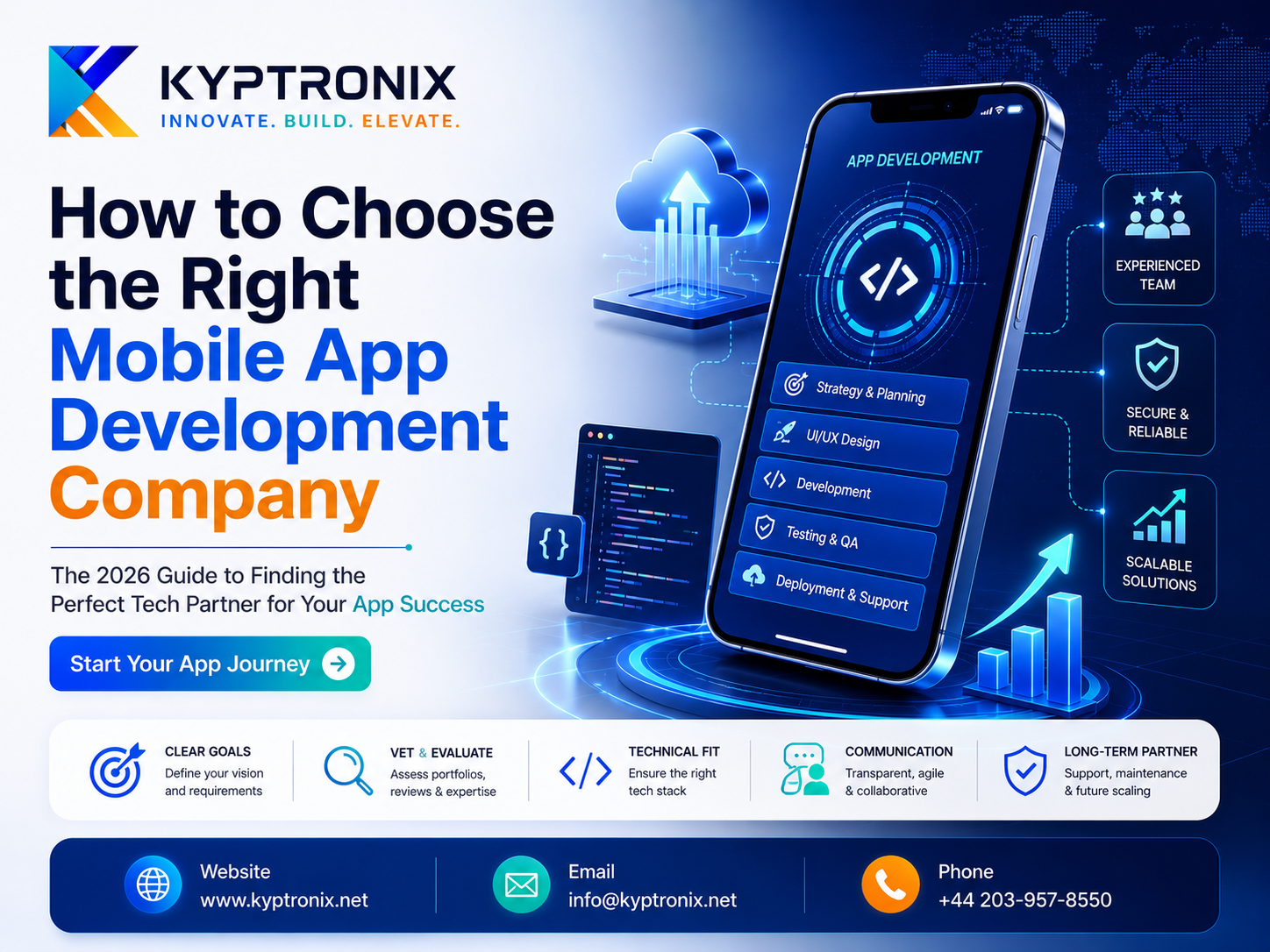
Step-by-Step Evaluation Framework: Navigating the Selection Roadmap
To eliminate guesswork and make a confident, objective hiring decision, your team should execute a structured evaluation process. Rushing straight into contract negotiations after seeing a slick sales presentation is one of the most common pitfalls in mobile app development agency selection.
Here is the step-by-step framework top tech leaders follow to find the right partner:
Define Goals, Scope, and Budget Parameters
Before reaching out to agencies, document your core business objectives, user personas, required feature sets, and compliance needs. Determine whether your initial goal is a rapid MVP or a full-scale enterprise system, and establish a realistic budget ceiling.
Conduct Targeted Vendor Sourcing & Portfolio Audits
Source potential development agencies through verified platforms like Clutch or GoodFirms. Examine their portfolios to verify recent experience building products in your industry or with similar technical complexity.
Evaluate Technical Architecture & Stack Specialization
Assess whether candidate agencies specialize in native iOS/Android development, cross-platform mobile app development, or serverless backend architectures. Match their technical strengths against your product roadmap.
Conduct In-Depth Interviews & Technical Q&A Rounds
Engage shortlisted firms in detailed discovery conversations. Assess their communication transparency, project management workflows, quality assurance testing protocols, and product design philosophies.
Audit Security, Compliance, and IP Terms
Review code ownership rights, non-disclosure agreements (NDAs), data encryption standards, and legal contracts to ensure your business retains 100% of the IP upon project completion.
Finalize SLA, Milestone Billing, & Maintenance
Execute a detailed Service Level Agreement (SLA) that clearly outlines project milestones, acceptance criteria, warranty windows, and ongoing post-launch app maintenance terms.
Comparative Analysis: Agency Delivery Models & Sourcing Regions
As you begin shortlisting potential partners, you will quickly discover that app development agencies come in various shapes, sizes, and operational models. One of your first strategic decisions will involve evaluating offshore vs onshore app development alongside different team structures.
To help you compare your options objectively, the matrix below breaks down the four primary vendor models used across the tech industry:
| Agency Delivery Model | Typical Cost Spectrum | Communication & Alignment | Technical Depth & Rigor | Risk Profile & Overhead | Ideal Project Fit |
|---|---|---|---|---|---|
| Independent Freelancers | $25 – $50 / hour | Variable; potential single-point-of-failure risks | Narrow; limited to individual skill set | High; minimal accountability or formal QA | Micro-bug fixes, simple prototypes, legacy patches |
| Onshore Boutique Agency | $120 – $220 / hour | High; shared timezone, cultural context, and language | High; specialized design and engineering focus | Low; formal contracts and localized legal recourse | Highly complex, localized regulatory or enterprise apps |
| Offshore Software Firm | $30 – $60 / hour | Requires structured asynchronous management | High technical execution; variable product strategy | Moderate; depends heavily on project management | Clear, highly specified feature builds with fixed scopes |
| Hybrid / Nearshore Model | $50 – $90 / hour | High; overlapping working hours and dual management | Deep full-stack teams with strategic consulting | Low to Moderate; optimal balance of cost and quality | Scaling tech startups, mid-market SaaS, and digital MVPs |
Strategic Takeaway
Choosing the cheapest option upfront often leads to missed deadlines, unoptimized code, and expensive fixes down the line. The goal should always be maximizing overall ROI, balancing cost efficiency with high-tier technical execution, clear communication, and strategic product guidance.
Critical Vetting Criteria: Beyond the Slick Sales Pitch
A confident sales deck and an impressive client logo list are nice, but they aren't enough to guarantee project success. When you decide to choose a mobile app development company, you need to look beneath the surface and evaluate their core operational capabilities.
Core Agency Vetting Pillars
TECHNICAL DEPTH
- • Native vs Cross-Platform
- • API Architecture
- • Cloud Security
DESIGN & UX
- • Research Depth
- • Prototyping
- • Usability QA
PROCESS & GOVERNANCE
- • Agile Sprints
- • Daily Standups
- • CI/CD Pipelines
1. Expertise in Custom Mobile Application Development
Generic, cookie-cutter app templates might work for simple personal projects, but commercial business apps require tailored software architecture. Ensure candidate agencies have proven experience in custom mobile application development. Ask them how they handle complex custom workflows, third-party API integrations such as payment gateways, CRM engines, or ERP systems, and dynamic database management.
2. Mastery of Modern Tech Stacks
Technology choices evolve rapidly. A forward-thinking development partner should be proficient in modern native languages (Swift for iOS, Kotlin for Android) as well as premier cross-platform mobile app development frameworks, such as Flutter or React Native.
Frameworks like Flutter, currently used by over 46% of cross-platform mobile developers globally, allow teams to build a single, high-performance codebase that deploys natively across both major operating systems, cutting initial development timelines and costs by up to 40% without compromising visual quality.
3. Understanding Real-World Mobile App Development Cost Factors
A reputable agency will never throw out a random, flat project quote during a 15-minute introductory call. They understand that mobile app development cost factors are multi-faceted and depend directly on:
- The total number of unique screens, user roles, and business permissions.
- Backend infrastructure requirements (microservices, serverless cloud setups, real-time database syncs).
- Security and compliance complexity (HIPAA, PCI-DSS, GDPR, SOC2 compliance).
- The depth of UI/UX research, wireframing, and interactive prototyping.
Top agencies begin engagements with a formal Discovery Phase to map out these technical details before locking in final milestone budgets.
4. A Disciplined Agile App Development Process
Building software requires continuous collaboration and flexibility. Look for partners who follow a disciplined agile app development process. Working in 2-week compilation cycles ("sprints") ensures your team receives regular functional builds, reviews progress during daily standups, and can adjust feature priorities based on real feedback without derailing the overall schedule.
5 Major Red Flags to Watch Out For During Vendor Interviews
1. Unrealistically Low Estimates
Agencies quoting prices significantly below market averages often rely on unvetted junior developers, skip quality assurance testing, or use hidden change-order clauses that inflate the final invoice later.
2. No Interest in Your Business Strategy
If an agency simply acts as an "order taker," nodding along without asking challenging questions about your target audience, revenue model, or user retention plan, they aren't acting as a true strategic partner.
3. Vague Statements on Intellectual Property
If an agency hesitates to explicitly state in writing that you will own 100% of the source code, design files, and proprietary assets upon payment, walk away immediately.
4. Skipping Automated Testing and Quality Assurance
Quality assurance is not an optional add-on. If an agency treats QA as an afterthought or expects you to perform all the testing yourself, your app will almost certainly suffer from high-profile crashes on launch day.
5. No Plan for App Store Compliance and Deployment
Navigating the strict approval guidelines of the Apple App Store and Google Play Store requires technical precision. Your vendor must have a clear strategy for managing app store compliance and deployment, privacy manifest declarations, and store reviewer queries.
The Interview Round: 7 Vital Questions to Ask Candidate Agencies
“Can you walk us through a recent project where you faced unexpected technical or architectural challenges, and how your team resolved them?”
“What specific project management tools (e.g., Jira, Trello, Slack) will our team have access to during sprint cycles?”
“How do your software engineers handle data encryption, API security, and protection against mobile vulnerabilities?”
“Will our project team consist of dedicated full-time resources, or will developers be split across multiple concurrent client accounts?”
“What is your exact process for managing scope changes or feature pivots midway through development?”
“Can you provide two or three verifiable client references from recent projects with similar technical scope?”
“What ongoing post-launch app maintenance options do you offer to handle OS updates, security patches, and server scaling?”
Conclusion: Transforming Your Mobile App Vision into Market Success
Choosing the right technology partner is the foundational decision upon which your digital product's entire future rests. By taking the time to carefully evaluate prospective agencies, auditing their technical depth, verifying client references, testing their communication transparency, and ensuring strict alignment with your long-term business goals, you turn a potentially stressful vendor search into a structured, highly successful investment.
When you are ready to choose a mobile app development company, you deserve an engineering partner that brings great technical skill, creative problem-solving, and complete operational transparency to the table.
At Kyptronix, we cut through the usual tech complexity. We don't just build applications or deal in AI automation. We partner closely with ambitious startups and growth-focused enterprises to engineer scalable, future-proof digital products. Whether you need to validate a new concept with a sleek cross-platform MVP or scale an enterprise system powered by cloud APIs, our global team of veteran product strategists, UI/UX designers, and full-stack mobile engineers is dedicated to delivering measurable business results.
Ready to turn your mobile app vision into a high-performing digital product? Connect with the product development team at Kyptronix.net today to schedule your comprehensive technical consultation.
Frequently Asked Questions (FAQs)
Mobile app development costs vary depending on complexity, features, and team structure. Simple MVPs typically range from $25,000 to $50,000, mid-complexity business apps range between $50,000 and $120,000, and complex enterprise platforms with custom backends can cost $150,000 to $300,000+.
On average, a lean Minimum Viable Product (MVP) takes 2 to 4 months to design, build, and launch. Medium-complexity apps average 4 to 7 months, while large-scale enterprise applications with extensive third-party integrations can take 8 to 12+ months.
If your product requires intense 3D graphics or ultra-low-latency hardware access, native development (Swift/Kotlin) is ideal. However, for 90% of business apps, cross-platform mobile app development frameworks like Flutter or React Native offer identical performance, single-codebase deployment for both iOS and Android, and 30 to 40% cost savings.
Before sharing proprietary business requirements, detailed feature specs, or wireframes with any prospective development firm, request that both parties sign a legally binding Non-Disclosure Agreement (NDA).
Onshore agencies operate in your home country, providing shared time zones and local legal recourse, but at higher hourly rates ($120–$220+/hr). Offshore agencies operate in regions with a lower cost of living ($30–$60/hr). Many modern businesses opt for hybrid models that combine local project management with global engineering talent.
You should always retain 100% ownership of the source code, design assets, databases, and intellectual property. Ensure your contract explicitly states that all IP transfers to your company upon final milestone payment.
Review verified client feedback on independent B2B rating platforms like Clutch or GoodFirms. Ask the agency for case studies with measurable outcomes and request direct contact details for past clients to ask about their experience.
Your contract or Service Level Agreement (SLA) should include clear milestone schedules, acceptance criteria, and sprint review protocols. Working with an agile methodology gives you bi-weekly visibility into progress, allowing you to catch delays early.
App development doesn't end at launch. A quality agency should offer ongoing maintenance packages covering operating system compatibility updates (annual iOS/Android releases), security patching, server scaling, bug fixes, and feature expansions.
A reputable development partner will handle the end-to-end deployment process. This includes setting up developer accounts, preparing store assets and privacy policies, building signed binaries, and addressing any questions or guidelines from Apple or Google reviewers.