The Clock is Ticking: How Long Does It Take to Build a Mobile App in 2026?
Imagine you are sitting in a strategy room, brainstorming a digital solution that could completely redefine how your company interacts with customers. The features look flawless on paper, the monetization strategy is indisputable, and the internal enthusiasm is electric. But just as the excitement peaks, someone at the table asks the ultimate execution question: “Realistically, how long before we can actually launch this in the app stores?”
If you have researched this question online before, you have likely encountered vague answers like “it depends.” Some low-code platforms claim you can spin up an application in an afternoon, while traditional enterprise software firms might quote a timeline that stretches past a year.
The truth is, tracking a mobile app development timeline is a multi-dimensional puzzle. Building an application is not a single, continuous coding block. It is a highly structured symphony of market validation, user interface design, full-stack database construction, security hardening, and navigating strict store approvals.
As we move through 2026, the timeline dynamics have shifted. While advanced engineering toolsets and AI-assisted compilation platforms help developers write code faster, the baseline requirements for modern apps, such as data privacy, real-time synchronization, and personalized AI features, have become significantly more complex.
Whether you are a non-technical founder aiming to launch a Minimum Viable Product (MVP) or an enterprise executive planning a major infrastructure update, this comprehensive guide provides an unvarnished, data-backed look at how long it truly takes to bring an app to life this year.
The Baseline Reality: Timelines by App Complexity
To establish realistic project timelines, you must first categorize your application by its structural complexity. The number of unique screens, the depth of your backend architecture, and the volume of third-party system integrations directly dictate your development schedule.
Based on industry-wide project delivery data compiled from global agency indices and software tracking metrics, here is how the typical mobile app development timeline breaks down by project scope:
| App Complexity Tier | Typical Delivery Window | Total Engineering Hours | Core Architectural Profile |
|---|---|---|---|
| Simple App / Lean MVP | 2 – 4 Months | 300 – 600 Hours | Single platform focus, basic local storage, standard UI components, minimal external APIs. |
| Medium Complexity App | 4 – 7 Months | 800 – 2,000 Hours | Cross-platform compatibility, secure user authentication, database syncing, payment gateways, custom admin dashboards. |
| Advanced / Complex App | 7 – 12+ Months | 2,000 – 5,000+ Hours | Multi-tenant cloud ecosystems, real-time sync pipelines, legacy system integrations, custom AI models. |
The 2026 Golden Rule: For a standard commercial product designed to support a growing customer base on both iOS and Android, you should expect a realistic mobile app development timeline of 5 to 8 months to safely navigate from initial concept discovery to an active app store listing.
Deconstructing the App Development Lifecycle Phase by Phase
To truly understand where your time is being spent, we need to lift the hood and look at the end-to-end app development lifecycle. A professional mobile application is created through a sequence of distinct, highly dependent milestones. Cutting weeks off the schedule requires an intimate understanding of how these phases are interconnected.
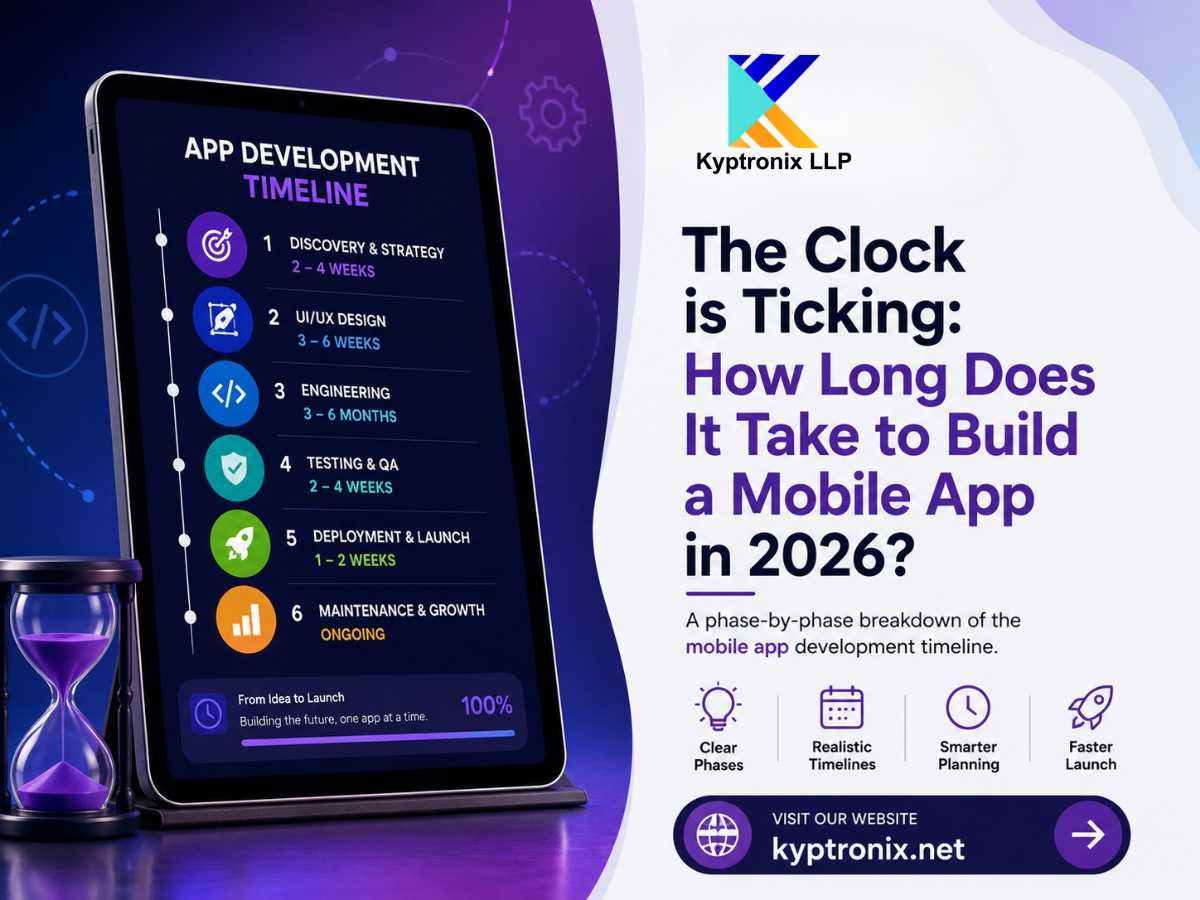
Let us trace the progress of a mobile product from a raw concept through the standard seven-stage journey. Here is a detailed, chronological breakdown of exactly what happens during each phase of this technical journey:
Phase 1: Discovery, Scoping, and Strategy: Average Duration: 2 to 4 Weeks.
Before any designer draws a pixel or a developer writes code, you must define the product's functional boundary. During this initial discovery window, business analysts and technical architects work with your team to draft a detailed Product Requirement Document (PRD). This process involves mapping target user personas, conducting competitive market analysis, mapping user stories, and establishing a clear compliance strategy, such as GDPR or HIPAA.
Phase 2: High-Fidelity UI/UX Design: Average Duration: 3 to 6 Weeks.
This phase transforms your abstract feature list into a concrete visual landscape. Designers begin by building structural user experience flows and low-fidelity wireframes to map how a user will navigate between core app functions. Once the underlying navigation is approved, they apply your brand typography, custom color palettes, and interactive micro-animations to create polished, high-fidelity clickable prototypes.
Phase 3: Technology Selection & Architecture Planning: Average Duration: 1 to 2 Weeks.
Here, your engineering leads select the optimal tech stack tailored to your long-term scaling needs. They establish whether your project will rely on native development toolkits or cross-platform options, map out the relational database schemas, design secure API endpoints, and set up the automated continuous integration and continuous deployment (CI/CD) pipelines.
Phase 4: Full-Stack Engineering (Frontend & Backend): Average Duration: 3 to 6 Months.
This is the most resource-heavy block of your total schedule. Production-grade software development runs on two parallel tracks: Frontend engineers meticulously translate static design files into clean, interactive interface code, while Backend architects build the server-side infrastructure, data storage engines, push-notification routers, and secure business logic layers.
Phase 5: Quality Assurance Testing & Optimization: Average Duration: 3 to 6 Weeks.
An app with great features will fail if it crashes on launch day. Dedicated QA analysts systematically run the application through a rigorous testing matrix. This includes functional verification, cross-device compatibility testing across various screen resolutions, data encryption audits, and load testing to ensure your backend remains rock-solid when thousands of concurrent users access the platform.
Phase 6: Mobile App Deployment & App Store Review: Average Duration: 1 to 2 Weeks.
Publishing your finalized application requires preparing asset metadata, draft privacy policies, and app store screenshots. The builds are then submitted directly to the Apple App Store Connect and Google Play Console. Your team must navigate the strict developer review guidelines, which typically take anywhere from 2 to 7 days for approval, depending on current queue volumes.
Phase 7: Post-Launch Growth and Maintenance: Ongoing Core Phase.
The day your app goes live is actually the beginning of its true product lifecycle. To maintain high store ratings and strong user retention, you must plan for continuous optimization cycles. This involves analyzing product metrics to identify drop-off points, squashing minor bugs reported by real users, and rolling out recurring software patches to ensure seamless compatibility with new operating system updates.
Core Variables: What Accelerates or Slows Down Your Schedule?
Two projects can have identical feature lists but experience completely different product delivery speeds. Understanding these underlying technical variables allows you to make smart architectural choices that protect your timeline from unexpected delays.
1. Choice of Architecture: Native vs. Cross-Platform
The baseline technologies you select for your codebase significantly influence your project's overall development speed:
- The Dual-Native Approach: Building separate apps using Swift for iOS and Kotlin for Android means your team is essentially managing two independent projects simultaneously. While this provides top-tier hardware optimization, it naturally extends your engineering timeline because features must be written and validated twice.
- The Cross-Platform Approach: Leveraging modern cross-platform mobile frameworks like Flutter or React Native allows developers to write a single, unified codebase that deploys natively across both operating systems. Choosing a cross-platform framework can shrink your engineering schedule by 30% to 45%, significantly accelerating your time to market for mobile apps.
2. Third-Party API Integrations and Legacy Infrastructure
If your mobile application functions as a self-contained ecosystem, storing user data locally or using a standard cloud database, the timeline is highly predictable. However, the moment your software requires communication with external platforms, the timeline can expand:
- Standard, well-documented APIs, such as connecting to Stripe for payments or Firebase for push alerts, can be integrated within a matter of days.
- Custom enterprise integrations, such as connecting your app to an old corporate SAP database or a proprietary healthcare EHR system, require specialized authentication handling, thorough data mapping, and extensive custom validation testing. This can easily add 4 to 8 weeks to your core engineering phase.
3. The Depth of Custom Features and Personalization
Every advanced feature you add directly impacts your testing and optimization loops. In 2026, implementing basic, template-based features will be fast. However, building custom predictive algorithms, setting up advanced real-time video streaming pipelines, or creating tailored generative AI recommendation engines requires precise data modeling and extensive tuning, which naturally expand your production schedule.
Managing Scope: The Power of an Agile Development Methodology
The single most common threat to a project's timeline is scope creep, the slow, gradual addition of new features midway through production that were never part of the initial plan. When teams attempt to build a perfect, fully featured application on their very first try, they often find themselves trapped in an endless development loop, missing their launch windows entirely.
To prevent this common pitfall, modern product teams rely heavily on an agile development methodology, as shown in the flowchart below:
Instead of trying to launch a massive software ecosystem all at once, an agile workflow breaks your roadmap down into distinct, 2-week compilation blocks called “sprints.” Every single sprint delivers a small, fully functional piece of the software that can be reviewed, tested, and optimized.
This iterative approach gives you deep visibility into the actual velocity of your engineering team. If a specific feature takes longer to build than initially expected, your project manager can adjust future sprints in real time, keeping your main release date safe.
The Critical Importance of Quality Assurance Testing
When founders face tight deadlines, they are often tempted to rush through the testing phase to get their product to market faster. This is almost always a costly strategic mistake. Discovering a major system bug after your application has been downloaded by thousands of users is significantly more expensive and time-consuming to fix than catching it during development.
Rushing your quality assurance testing frequently leads to a wave of negative 1-star reviews on the app stores, which can permanently damage your app's search visibility and user acquisition efforts.
Comprehensive testing requires a dedicated window of 3 to 6 weeks to execute properly. During this time, QA professionals run the application through various testing methodologies, such as:
- Regression Testing: Ensuring that new code updates do not accidentally break existing, stable features.
- Network Condition Testing: Verifying that your app handles transitions smoothly when moving from a fast 5G connection to a weak Wi-Fi signal without losing user data.
- Edge-Case Security Testing: Simulating unauthorized login attempts and malicious data inputs to ensure your user databases remain fully secure.
Maximizing Organic Discovery: Concurrent App Store Optimization
While your engineering team is busy finalizing the codebase, your marketing and product management teams should be actively preparing your go-to-market strategy. You do not have to wait until the app is fully built to begin your launch logistics.
To build strong momentum from day one, you should launch a comprehensive app store optimization (ASO) campaign at least a month before your target release date:
- Keyword Optimization: Research and select high-volume search phrases to integrate naturally into your app's title, subtitle, and metadata fields.
- Visual Asset Design: Craft compelling app icons and polished store screenshots that clearly show off your app's core value proposition to browsing users.
- Pre-Registration Campaigns: Set up pre-registration listings on both the Google Play Store and Apple App Store, allowing interested users to sign up so the app downloads automatically to their devices the moment it launches.
By running your marketing and engineering workflows in parallel, you can maximize your visibility and begin climbing the store charts the very second your application passes review.
Strategic Acceleration: How to Launch Faster Safely
If your business is operating under strict competitive pressure or a tight funding timeline, there are several proven strategies you can use to compress your schedule without sacrificing code quality:
- Prioritize a Lean Minimum Viable Product (MVP): Strip away secondary, non-essential features and focus entirely on building your core value proposition. Launching a refined Minimum Viable Product (MVP) allows you to get your product into the market quickly, gather real-world user feedback, and validate your business assumptions before investing heavily in secondary features.
- Leverage Pre-Built Frameworks and BaaS: Avoid reinventing the wheel. Use trusted, secure third-party platforms, for example, Firebase, Supabase, or AWS Amplify, to handle standard backend infrastructure like user authentication, file storage, and data hosting. This allows your developers to spend their time building your unique core features instead of setting up basic infrastructure.
- Partner with a Specialized Development Agency: Trying to recruit, onboard, and manage an internal development team from scratch can easily add 2 to 3 months of overhead to your project before a single line of code is written. Partnering with an established software development firm gives you instant access to a fully coordinated team of veteran designers, developers, and QA specialists who are ready to hit the ground running.
Conclusion: Let Us Build Your Next Digital Innovation Together
Calculating an accurate mobile app development timeline can easily feel like a balancing act, but you do not have to navigate this complex process alone. The key to maintaining a fast, predictable delivery schedule is choosing a technology partner who values transparent planning, clean code, and open communication from the very first meeting.
At Kyptronix, we cut through the guesswork. We blend deep product strategy with world-class technical execution to ensure your mobile application launches on schedule and within budget. Whether you want to enter the market quickly with a lean, beautifully crafted cross-platform Minimum Viable Product (MVP) or scale your existing operations with a secure, highly advanced enterprise ecosystem, our dedicated team is here to guide you smoothly through every milestone of the journey.
Ready to stop guessing and get a clear, custom roadmap for your product? Connect with the digital product engineering team at Kyptronix.net today, and let us map out the most efficient path to bring your vision to life.
Frequently Asked Questions (FAQs)
Developing an app is an intricate, multi-stage engineering process. It requires ample time to thoroughly research user workflows, design beautiful interfaces, build secure backend server code, connect external APIs, and run extensive cross-device quality assurance testing to ensure a stable, high-performance product at launch.
You can build a simple, single-purpose application or a basic prototype within a month by using no-code app builders or pre-designed templates. However, for a unique, production-grade business application that requires custom backend logic, secure payment processing, and scalable user databases, a realistic timeline requires a minimum of 2 to 3 months of custom engineering.
Cross-platform mobile frameworks like Flutter and React Native allow developers to write a single, unified codebase that compiles and runs smoothly on both iOS and Android. This cuts your frontend coding time and testing loops nearly in half, shrinking your total production timeline by 30% to 45% compared to parallel native builds.
The most common cause of project delays is scope creep, i.e., the practice of introducing new features or making major design pivots midway through the development phase. This breaks your team's sprint planning, disrupts architectural foundations, and requires extensive code rewrites and extra testing loops.
Once you submit your finalized build, the automated and manual review process typically takes between 2 and 5 days for the Apple App Store and 3 to 7 days for the Google Play Store. It is always wise to budget a full week in your launch schedule to handle any clarifying questions or adjustments requested by the platform reviewers.
If you are building your application natively, choosing a single platform to start with can save you several weeks of initial development time. If your target market is primarily based in North America or Western Europe, launching on iOS first is often highly strategic. For global audiences, Android is usually the logical starting point. However, using a cross-platform framework like Flutter allows you to launch on both storefronts simultaneously without extending your timeline.
For most standard business applications, you should plan to spend roughly 4 to 8 weeks on the combined discovery, scoping, and UI/UX design phase. Investing this time upfront ensures your team locks in clear feature requirements, maps out intuitive user journeys, and establishes a solid architectural plan before any coding begins.
A well-rounded, efficient product team typically consists of 4 to 6 specialized professionals, comprising a dedicated Project Manager/Scrum Master, a UI/UX Designer, 1 or 2 Full-Stack Developers, a Quality Assurance Analyst, and a DevOps Architect to handle cloud deployment.
An agile development methodology organizes your development roadmap into short, focused 2-week sprints. Each sprint delivers a specific, testable piece of the application. This gives you deep visibility into your team's progress, allows you to catch technical bugs early, and makes it easy to adjust your plan in real time to protect your target launch date.
Yes. Launching your application is simply the first milestone of its lifecycle. To maintain high user retention and strong app store visibility, you must plan for ongoing support. This involves deploying routine security updates, squashing user-reported bugs, and rolling out seasonal feature enhancements to stay ahead of competitors.