The Complete Mobile App Development Process Explained: 2026 Guide
Imagine you have identified a glaring gap in the market, sketched out a brilliant solution on paper, and decided it is time to build an app. You are fired up and ready to disrupt your industry. But then reality sets in. How do you actually get from a paper sketch to an application that thousands of people download, love, and open daily?
With the global mobile application market projected to touch a massive $330.02 billion in 2026, the stakes have never been higher, and the execution has never been more complex. Building a successful product is no longer just about writing functional code. It requires balancing data privacy laws, cutting-edge AI integrations, and the subtle art of keeping users hooked in an ecosystem where the average person already interacts with 30 different applications every month.
The difference between a multi-million-dollar digital product and an abandoned software asset comes down to how you navigate the mobile app development process.
This comprehensive, data-backed guide simplifies the entire app development lifecycle, laying down a clear, phase-by-phase roadmap to build a competitive, future-proof mobile application this year. Hence, let's get started.
The Bird's-Eye View: The Mobile Product Lifecycle
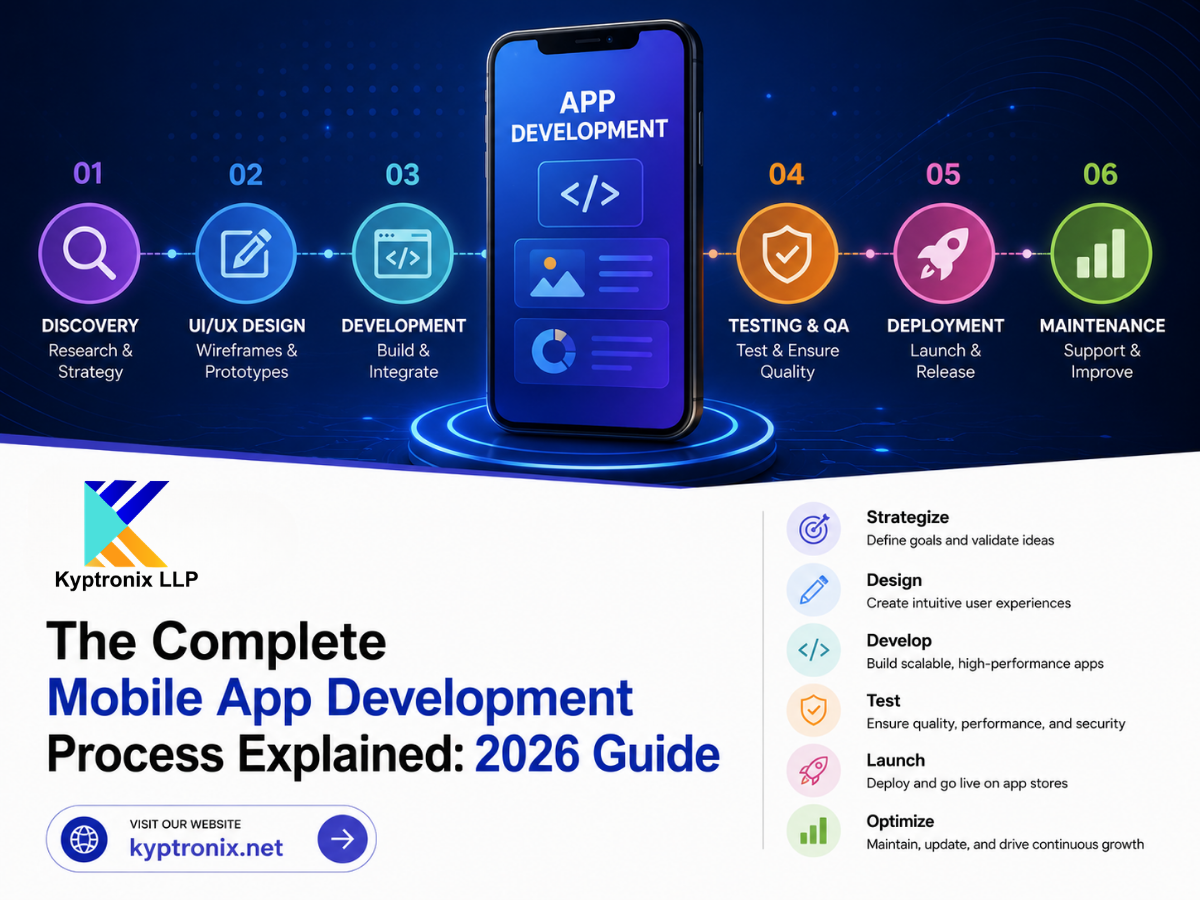
Before we dive into the technical details, let us look at how a professional digital product moves from an abstract concept into a living, scaling system. The modern mobile app development process is non-linear, an iterative loop in which design, testing, and engineering consistently inform one another. Therefore, we have created a phase-by-phase table outlining the complete mobile app development process.
| Phase | Core Objective | Primary Deliverables | Typical Timeline |
|---|---|---|---|
| 1. Discovery & Strategy | Market validation & scope definition | Product Requirement Document (PRD), Competitor Matrix | 2 – 4 Weeks |
| 2. UI/UX Design | Visual identity & user journey mapping | Wireframes, Clickable High-Fidelity Prototypes | 3 – 6 Weeks |
| 3. Full-Stack Engineering | Writing scalable frontend & backend code | Alpha/Beta Builds, Functional Backend Architecture | 8 – 24 Weeks |
| 4. Testing & QA | Eliminating bugs & vulnerability risks | QA Test Logs, Security Audit Reports, Performance Benchmarks | 2 – 4 Weeks |
| 5. Deployment & Launch | Publishing to global app marketplaces | Live App Store Listings, Approved Production Environment | 1 – 2 Weeks |
| 6. Maintenance & Growth | Scaling systems & retention optimization | Analytics Dashboards, Regular Feature Patches, ASO Updates | Ongoing |
To help you visualize this continuous journey, the standard industry workflow breaks down into seven distinct, interconnected phases, which are as follows:
Phase 1: Research, Validation, and Mobile App Development Strategy
Every great app starts with an idea, but an idea alone is not a business model. Jumping straight into coding without a clear, data-driven mobile app development strategy is the number one reason mobile products fail. This initial discovery phase is where you stress-test your concepts against real-world market constraints.
Market Sizing and Competitor Analysis
You must understand exactly who your competitors are and what they are lacking. For example, if you are building a FinTech app, how do existing legacy banking platforms alienate younger demographics? If you are launching a healthcare solution, what friction points do patients experience in current telehealth portals? Therefore, correctly identifying the following two pointers gets phase 1 underway comfortably.
- Identify the Core Value Proposition: What is the single feature your app provides that users cannot find anywhere else?
- Map the User Persona: Define your typical users. Are they Gen-Z shoppers who expect instant, TikTok-style vertical videos, or busy B2B managers who prioritize clean, text-based data summaries?
Technical Feasibility & Monetization Blueprints
Strategy also means mapping your financial engine. Industry reports confirm that in 2026, the in-app purchases and subscription segment is expected to dominate the market with a massive 64.2% share. So, the question here is: will your product rely on a freemium structure, tier-based monthly subscriptions, or marketplace transaction commissions? Your choice here fundamentally changes how your backend architecture handles transactional events down the road.
Phase 2: Product Architecture and Planning
Once your strategy is validated, you need to turn those high-level business goals into precise, actionable technical requirements. This is where your product managers and technical architects map out the structural blueprint of the software.
The Power of an Agile Development Methodology
Modern development teams rarely use the old-school “Waterfall” process, where everything is built in one massive block before anyone tests it. Instead, they rely on an agile development methodology.
By breaking your project down into 2-week development windows called “sprints,” you can continuously build, test, and adjust your features based on real feedback. This flexibility ensures your project stays highly responsive and prevents costly delays.
Choosing Your Stack: Native vs. Cross-Platform Frameworks
One of the most critical decisions in the app development lifecycle is choosing the foundation of your codebase. This choice impacts both your initial budget and your long-term scaling potential. Hence, choose wisely from the two options explained below.
- Native Development (Swift for iOS / Kotlin for Android): Native development offers deep, uncompromising performance and seamless access to on-device hardware, like advanced camera processing or core machine learning pipelines. It is the premier choice for graphics-heavy gaming or high-performance financial tools.
- Cross-Platform Frameworks (Flutter / React Native): Cross-platform development allows software engineers to write a single, unified codebase that deploys natively across both iOS and Android platforms simultaneously. Industry benchmarks show that opting for cross-platform tools can slash your overall development costs and time-to-market by 30% to 50%, making it an exceptionally popular route for growing businesses.
Phase 3: UI/UX Design for Mobile
An app can have the most advanced algorithms in the world, but if it is confusing or frustrating to navigate, users will delete it within minutes. UI/UX design for mobile is the process of making your application intuitive, accessible, and delightful to interact with. The flowchart below explains the UI/UX design for mobile apps.
1. User Experience (UX) Mapping
UX designers focus heavily on structural navigation. They create low-fidelity wireframes that are essentially clean digital skeletons of your screens, created to establish the absolute shortest path for a user to accomplish a goal. Whether that means completing an e-commerce checkout or logging a daily workout, the fewer clicks required, the better.
2. User Interface (UI) Polish
Once the skeleton is locked in, UI designers bring it to life. They select typography, establish brand-aligned color palettes, design custom iconography, and build subtle micro-interactions, like a satisfying button animation when a task is completed. In 2026, top-tier UI design must balance aesthetics with strict accessibility standards, ensuring target click regions are easy to tap and color contrast choices remain highly readable for all users.
Phase 4: Full-Stack Engineering & Building the MVP
This is where your product moves from design prototypes to functional, working software. The engineering phase splits into two parallel production tracks that work in perfect harmony.
The Backend Architecture (The Hidden Engine)
The backend is the server-side foundation that powers your app. It handles user authentication, securely processes financial payments, manages database storage, and processes data logic. Modern backends leverage cloud-native infrastructure like AWS or Google Cloud, allowing your system to scale up automatically when web traffic surges.
The Frontend Interface (The User-Facing Layer)
Frontend engineers take the static designs from your UI team and translate them into clean, highly responsive code. They ensure that every screen transition is smooth, data loads instantly, and the application functions flawlessly across multiple screen sizes and hardware specifications.
Focusing on the Minimum Viable Product (MVP)
When bringing a brand-new concept to market, smart businesses avoid building every single imaginable feature on day one. Instead, they focus on launching a Minimum Viable Product (MVP).
An MVP is a lean, highly stable version of your application that includes only your core, must-have features. Launching an MVP allows you to enter the market quickly, gather real-world user feedback, and validate your business model before investing heavily in secondary features.
Phase 5: Quality Assurance Testing (QA)
You should never let your end users act as your quality-control team. A single high-profile crash on launch day can permanently damage your brand's digital reputation. A dedicated quality assurance testing phase is non-negotiable to find and fix bugs before your app reaches the public.
Professional QA analysts execute a rigorous testing matrix across multiple dimensions, which are:
- Functional Testing: Verifying that every single feature, link, button, and data form behaves exactly as outlined in your initial product documentation.
- Performance & Load Testing: Testing how the application handles stress. For instance, does the app launch in less than 2 seconds on mid-tier hardware? Does the backend maintain structural integrity when thousands of users interact with the system simultaneously?
- Security & Penetration Testing: Auditing data storage environments, checking for server vulnerabilities, and ensuring all user data transactions use end-to-end encryption. This is especially vital for healthcare or FinTech apps handling sensitive personal records.
Phase 6: Mobile App Deployment and App Store Compliance
Once your app is thoroughly tested and approved by QA, it is time for mobile app deployment. This means submitting your application to the Apple App Store and Google Play Store.
However, getting approved is not always easy. Industry data reveals that roughly 25% to 40% of first-time app submissions face initial rejections. The review process has become even more rigorous recently due to strict new platform guidelines, which are explained below:
- 1. Target Modern System SDKs (Mandatory Rule): Apple requires all app submissions to be built using the modern Xcode 26 and iOS 26 SDKs. Your engineering team must update all third-party software libraries to avoid instant automated rejection at submission.
- 2. Implement AI Data Consent Screens (Privacy Rule): If your app connects to external generative AI models or LLM systems to process data, you must show a clear, upfront consent screen. This screen must tell users exactly what data is shared and get their explicit approval.
- 3. Complete Privacy Manifests & Labels (Compliance Rule): You must fill out detailed privacy and nutrition labels inside your developer accounts. Every third-party SDK integrated into your application must include a signed privacy manifest document to prevent background user tracking.
Phase 7: Post-Launch Growth and App Store Optimization (ASO)
Congratulations, your app is officially live! But the mobile app development process does not stop at the launch party. Now, your focus shifts to driving visibility, monitoring performance, and keeping your users engaged.
Driving Organic Discovery with App Store Optimization (ASO)
With millions of apps competing for attention, you cannot simply cross your fingers and hope people find yours. You must actively invest in app store optimization (ASO), which involves:
- Keywords and Metadata: Weave high-intent target search phrases directly into your application title, subtitle, and primary description fields to boost your rankings in search results.
- Visual Assets: Use clean, high-conversion screenshots and brief preview videos that highlight your app's core features to drive higher click-through rates from potential users.
The Maintenance Loop: Updates and Optimization
To maintain a high rating on the app stores, you must continuously review user feedback and release regular updates. This means monitoring analytics platforms to spot where users drop off, fixing minor bugs, and rolling out seasonal feature enhancements to boost long-term retention.
Choosing the Right Technology Partner
Navigating the full mobile app development process takes an immense amount of technical skill, strategic design thinking, and launch experience. Trying to manage all of these moving parts on your own can quickly drain your internal resources and lead to costly delays.
Thus, at Kyptronix, we treat your app ideas like our own. We combine deep business strategy with world-class engineering to build highly secure, beautiful, and scalable mobile products. Whether you want to validate a new business idea with a fast, reliable Minimum Viable Product (MVP) or build an enterprise-level platform with custom AI features, our team has the expertise to guide you smoothly through every phase of the app development lifecycle.
Ready to take your digital product from concept to launch? Connect with the product development specialists at Kyptronix.net today, and let us build something incredible together.
Frequently Asked Questions (FAQs)
The Discovery and Strategy phase is the most critical. Skipping market validation or failing to define a clear product requirement document frequently leads to scope creep, massive budget overruns, and building features that users do not actually want.
An agile development methodology breaks the project into small, manageable 2-week sprints. This allows the team to test features continuously, uncover potential bugs early, and make quick adjustments based on feedback, preventing major re-engineering costs later on.
Using cross-platform frameworks like Flutter or React Native allows your team to build and maintain a single codebase that runs beautifully on both iOS and Android. This cuts your timeline and development expenses by 30% to 50% compared to building two separate native apps.
Most rejections stem from preventable issues like missing test account credentials for reviewers, app stability crashes, incomplete privacy manifest declarations, or failure to include mandatory AI data consent modals.
It includes user experience architecture (creating wireframes and user flow mapping to ensure navigation is intuitive) and user interface styling (polishing visual assets, typography, color themes, and custom animations).
On average, high-performing applications launch updates 1 to 2 times per month. These updates are essential to roll out minor bug fixes, patch security updates, ensure compatibility with new OS versions, and launch new features based on user feedback.
A Minimum Viable Product (MVP) is built to get your core value proposition into the hands of real users as fast as possible. This approach lets you gather valuable real-world data and validate your business model before committing a large budget to secondary features.
App store optimization (ASO) improves your organic visibility inside the app stores. By optimizing titles, descriptions, and keywords, your app ranks higher in search results, driving consistent, free organic downloads without relying entirely on paid advertising.
QA engineers run your app through a series of automated and manual tests. They check for code bugs, measure loading speeds under heavy simulated traffic, test data security encryption, and ensure the layout looks flawless across multiple device screen sizes.
If your app requires complex graphics processing, real-time device hardware syncs, or high-end native device processing, choose native development. For standard business applications, e-commerce stores, and SaaS platforms looking to maximize budget, cross-platform frameworks are usually the ideal choice.