How Much Does It Cost to Build a Mobile App in 2026? A Complete Guide
Have you ever had an incredible app idea strike you out of nowhere, only to find yourself immediately stopped by a massive, looming question: “How much is this actually going to cost me?”
If you have spent any time looking for an answer online, you already know how frustrating the search can be. One agency website promises a complete product for $10,000, while an industry report states that anything under $250,000 is a waste of time. It feels a bit like walking into a car showroom and asking, "How much does a vehicle cost?" The true answer is always: “It depends entirely on what you want under the hood.”
As we move through 2026, the mobile ecosystem is more dynamic than ever. Building an app is no longer just about pushing static pixels onto a screen. It is about creating an AI-ready, highly secure, and deeply personalized ecosystem.
Whether you are a startup trying to launch your first Minimum Viable Product (MVP) or an established enterprise scaling your digital infrastructure, this transparent guide breaks down the true mobile app development cost in 2026 with real, honest data.
The Quick Answer: Average Cost to Build an App in 2026
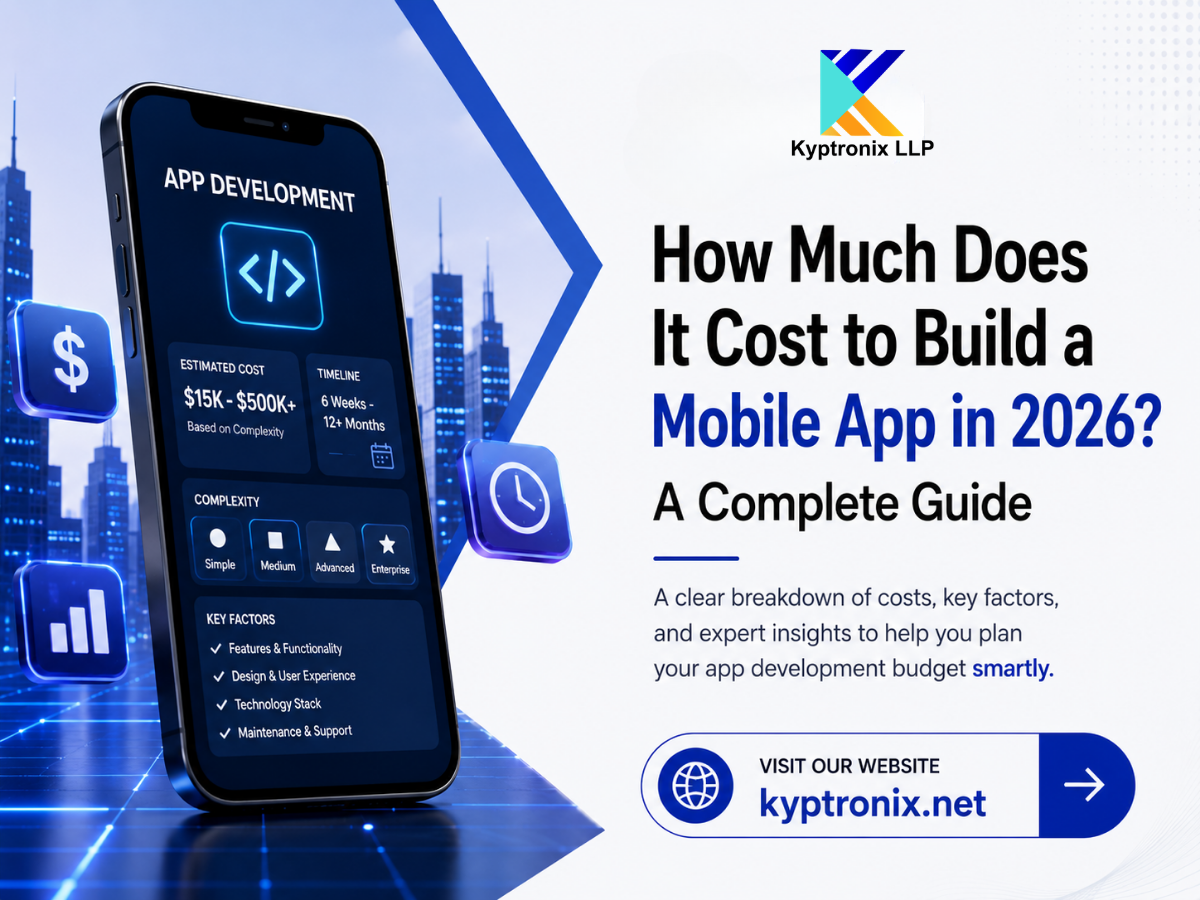
If you are looking for an immediate benchmark to guide your budget planning, the general market consensus for mobile app development spans a wide but predictable spectrum. Based on recent cross-industry surveys from Clutch and global agency pricing indices, here is how the numbers stack up by project scope:
| App Complexity Tier | Typical Cost Range (USD) | Average App Development Timeline | Archetypical Examples |
|---|---|---|---|
| Simple App / Basic MVP | $15,000 – $40,000 | 6 – 10 weeks | Internal business tools, static content guides, and basic booking MVPs |
| Medium Complexity App | $40,000 – $120,000 | 3 – 6 months | E-commerce stores, on-demand delivery, custom marketplace platforms |
| Advanced / Complex App | $100,000 – $250,000 | 6 – 12 months | Telemedicine platforms, real-time logistics software, and social media clients |
| Enterprise-Grade Platform | $250,000 – $500,000+ | 12+ months | Neobanking apps, massive multi-tenant SaaS, legacy system overhauls |
The 2026 Baseline Rule: For a professionally built, growth-stage cross-platform app featuring native integrations, custom APIs, and user authentication, most standard business projects land inside a median bracket of $50,000 to $150,000.
Deep Dive: Breaking Down Mobile App Development Cost by Complexity Tiers
To understand where your product fits on this financial spectrum, let us zoom in on each of these app complexity tiers. What do you actually get for your investment at each level?
1. Simple Apps & MVPs ($15,000 – $40,000)
A simple application serves a single, highly refined purpose with minimal backend infrastructure. In 2026, these will rarely be built completely from scratch. Smart teams rely on Backend-as-a-Service (BaaS) platforms like Firebase or Supabase to drastically cut down server provisioning times.
What is included: 5 to 10 standard screens, basic email/social login, a simple administrative dashboard, standard push notifications, and basic data storage.
The Technology: Typically built using rapid cross-platform deployment toolkits or low-code frameworks like FlutterFlow for rapid market validation.
Ideal For: Startups seeking early concept validation, small community applications, or hyper-focused internal business utilities.
2. Medium Complexity Apps ($40,000 – $120,000)
This tier represents the true sweet spot for most funded startups and expanding Small to Medium Businesses (SMBs). These apps do not just display information; they process complex business logic, handle real-time data syncs, and securely exchange financial value.
What is included: Custom UI/UX design components (no generic templates), advanced payment gateway integrations (Stripe, Braintree, localized wallets), multi-role user management, sophisticated search engines with filtering, and native hardware access (GPS tracking, camera usage).
The Technology: Production-grade cross-platform frameworks like Flutter or React Native, backed by serverless cloud architectures (AWS Lambda, Google Cloud Functions) that keep early-stage hosting overhead low.
Ideal For: On-demand service platforms (think food delivery or localized home services), traditional e-commerce brands, and mid-market B2B SaaS mobile clients.
3. Advanced & Complex Applications ($100,000 – $250,000+)
When performance, hyper-low latency, and complex processing are non-negotiable, you step into the advanced category. These applications handle immense data loads and usually offer deep, personalized user journeys.
What is included: High-fidelity custom animations, multi-language/multi-currency capabilities, real-time peer-to-peer audio/video streaming, offline-first operational synchronization, and custom-built API layers designed to sync with legacy software.
The Technology: Often relies on a hybrid or fully native architecture approach (Swift for iOS and Kotlin for Android) combined with automated deployment pipelines (CI/CD) to manage continuous updates safely.
Ideal For: Multi-vendor marketplaces, interactive EdTech platforms with live classrooms, and full-scale social networks.
4. Enterprise-Grade Solutions ($250,000 – $500,000+)
Enterprise app development is a completely separate category. At this scale, you are not just launching a mobile app. You are anchoring an entire business ecosystem that must support millions of concurrent connections while defending against advanced security threats.
What is included: Military-grade end-to-end encryption, multi-tenant database partitioning, seamless integrations with corporate enterprise resource planning (ERP) systems, such as SAP or Oracle, and intense regulatory compliance layers.
The Technology: Microservices-based cloud architecture hosted on highly resilient Kubernetes clusters, alongside dedicated automated testing suites that execute thousands of security vulnerability checks per build.
Ideal For: Digital banking platforms, healthcare networks requiring strict data privacy handling, and global logistics conglomerates.
Phase-by-Phase Cost Allocation: Where Does the Money Go?
Many first-time app founders assume that 95% of their budget goes directly to a software engineer typing lines of code. In reality, modern product development is a highly structured, multidisciplinary journey.
To help visualize how a typical project budget is distributed across these essential steps, take a close look at this industry-wide breakdown.
Let us unravel exactly what happens during each critical milestone of this lifecycle to see how the financial investment translates into real-world progress:
Phase 1: Ideation, Strategy & Market Research (5% – 10% of Budget)
Before a single wireframe is drawn, you must define the exact technical and business foundation of the product. This stage is known as the Discovery Phase. It involves mapping user personas, studying your direct competitors, evaluating technical risks, and establishing a clear Feature Roadmap. Skipping this step is the single most common cause of budget overruns later in a project.
Phase 2: UI/UX Design & Prototyping (10% – 15% of Budget)
Your application's interface is your digital storefront. In this phase, product designers create low-fidelity wireframes to outline the basic user journey, which are then refined into high-fidelity clickable interactive prototypes. This gives you a clear visual look at exactly how your app will function before an engineering team begins building the underlying technical code.
Phase 3: Core Frontend & Backend Development (50% – 60% of Budget)
This is the most asset-intensive and resource-heavy window of the timeline. The engineering team splits into two complementary tracks: Frontend developers work diligently to build the visible interactive screens, while Backend architects construct the hidden logic systems, database schemas, and secure API infrastructure that power the entire platform.
Phase 4: Rigorous Quality Assurance & Testing (10% – 15% of Budget)
Flawless apps do not happen by accident. Dedicated QA engineers systematically stress-test the application across dozens of real device configurations and operating system versions. They conduct thorough functional testing, look for security vulnerabilities, and perform load testing to guarantee your software will remain rock-solid when thousands of users download it simultaneously.
Phase 5: Deployment & Launch Logistics (3% – 5% of Budget)
Publishing an app involves navigating the strict submission guidelines of the Apple App Store and Google Play Store. This phase covers setting up production servers, configuring cloud delivery networks (CDNs), applying for necessary developer accounts, and optimizing store listings to ensure smooth approvals from store reviewers.
Key 2026 Cost Drivers: What Accelerates the Invoice?
Two applications can look almost identical on the surface but carry completely different price tags. Understanding these primary underlying mobile app development cost variables will help you make strategic design choices that keep your project on budget:
1. Platform Choice: Cross-Platform vs. Dual Native
Deciding how your app is built fundamentally changes your engineering resource requirements:
- The Native Path (Swift/Kotlin): Building separate dedicated apps for iOS and Android means maintaining two completely distinct codebases. While this provides top-tier performance and fluid access to complex hardware features, it essentially doubles your long-term engineering spend.
- The Cross-Platform Path (Flutter/React Native): Modern cross-platform frameworks allow a team to write a single, unified codebase that deploys beautifully to both iOS and Android. This strategic choice saves 30% to 45% on initial build costs and significantly simplifies ongoing maintenance.
2. The “AI Premium” and Advanced Feature Integration
In 2026, integrating artificial intelligence is no longer an exotic luxury. Rather, it is a standard user expectation. However, the depth of this implementation acts as a major budget driver:
- Integrating a basic wrapper for a public LLM via a standard API is relatively straightforward, ranging between $5,000 and $12,000.
- Building custom predictive machine learning models, deploying local edge-AI processing capabilities, or engineering complex vector databases for personalized recommendations can easily add $20,000 to $50,000+ to your project scope.
3. Compliance and Data Security Requirements
If your mobile application processes sensitive user details, you must build specialized compliance infrastructure right into your system architecture:
- Healthcare Apps: Implementing comprehensive audit logging and encrypted data environments to meet strict medical privacy standards, like HIPAA, can add an extra $25,000 to $60,000 to a project.
- FinTech Apps: Meeting payment card standards, like PCI-DSS, or financial data rules requires multi-layer authentication and regular external security audits, which naturally increase your engineering timeline.
Geographic Reality: How Developer Location Shifts the Math
The physical location of your development team is often the single most influential variable affecting your total bottom-line investment. Software engineering rates vary dramatically across global economic regions due to local living costs, even when talent levels are completely equal.
| Development Region | Junior Developer Rate | Mid-Level Engineer | Senior Architect Rate |
|---|---|---|---|
| United States / Canada | $50 – $80 / hr | $80 – $130 / hr | $130 – $200+ / hr |
| United Kingdom / Western Europe | $45 – $70 / hr | $70 – $110 / hr | $110 – $170+ / hr |
| Eastern Europe (Poland, Ukraine) | $25 – $40 / hr | $40 – $70 / hr | $70 – $100+ / hr |
| India / South Asia | $10 – $20 / hr | $20 – $40 / hr | $40 – $70 / hr |
Let us look at a realistic breakdown of average hourly app developer rates in 2026 across major global engineering hubs in 2026:
Maximizing Your Technical ROI via Strategic Outsourcing
Looking at this global landscape highlights why outsourcing development to a highly qualified agency in India remains an incredibly popular strategic move for businesses worldwide.
Choosing this path is no longer just about searching for the absolute lowest cost. It is about accessing elite technical expertise. India has become a premier global hub for cutting-edge specialized software fields like Flutter, React Native, and generative AI engineering. By partnering with an established, high-performing offshore agency, you get access to top-tier senior software architects for a fraction of the cost of a domestic team, ensuring you maximize every dollar of your budget.
Hidden Post-Launch Costs Founders Often Forget
A successful launch is not the final finish line of an application's life cycle. It is actually the beginning of its real-world journey. To keep your application running smoothly, you must plan for ongoing operational expenses from day one.
- 1. Allocate an Annual Maintenance Fund: App maintenance costs for 2026 is between 15% to 20% of the initial cost annually. Every single year, Apple and Android roll out massive operating system updates. Your application requires consistent minor updates to patch security vulnerabilities, squash user-reported bugs, and update third-party library dependencies so it stays functional on newer smartphones.
- 2. Budget for Scalable Cloud Hosting: Scales dynamically with user growth. Your database and backend servers require ongoing hosting support. While simple early-stage MVPs can run comfortably on cloud hosting tiers under $100 per month, a fast-growing application with real-time sync needs can expect infrastructure costs to scale up as thousands of concurrent users join the platform.
- 3. Account for Digital Platform Fees: Fixed account fees plus transactional commissions. To publish your application, you must keep active platform accounts. Google Play requires a simple one-time $25 fee, while Apple charges an ongoing $99 annual developer fee. Additionally, if you sell digital goods or subscriptions inside your app, be sure to account for standard store transaction fees, which typically range between 15% and 30%.
- 4. Launch a Focused App Store Optimization (ASO) Campaign: Crucial for driving organic user downloads. Even the most beautiful application in the world will fail if nobody knows it exists. Plan to invest an ongoing portion of your budget into continuous App Store Optimization, organic content production, and structured user acquisition campaigns to cut through the noise of crowded digital storefronts.
Conclusion: Let Us Turn Your App Vision into Reality
Calculating the exact mobile app development cost can easily feel overwhelming, but you do not have to map out this complex journey all on your own. The secret to avoiding unexpected budget overruns is simple: choose an expert, collaborative technology partner who values clear, honest communication from the very first consultation.
At Kyptronix, we pride ourselves on helping businesses cut through the noise. We combine world-class software engineering with strategic, budget-conscious product planning. Whether your goal is to disrupt an entire industry with an advanced AI-powered platform or validate a brilliant new idea with a lean, lightning-fast cross-platform MVP, our dedicated team is here to engineer scalable, future-proof software tailored directly to your unique business goals.
Ready to stop guessing and get a clear, custom blueprint for your product? Connect with the development team at Kyptronix.net today, and let us map out an efficient path to bring your application to life.
Frequently Asked Questions (FAQs)
A standard MVP usually takes around 2 to 3 months to design, develop, and launch. Medium complexity apps average between 3 and 6 months, while complex enterprise platforms require 6 to 12+ months of development time to manage intricate backend systems and rigorous QA verification.
Yes, you can build a highly focused Minimum Viable Product (MVP) or an internal tool within this range. To do this effectively, your development team will typically leverage modern cross-platform development toolkits, pre-built design systems, and serverless architectures to minimize custom code generation.
For the vast majority of commercial projects, cross-platform frameworks like Flutter or React Native are much more cost-effective. They allow your team to write a single codebase that deploys seamlessly to both iOS and Android, reducing your initial development and long-term maintenance costs by up to 40% compared to parallel native builds.
The most common ongoing costs include cloud infrastructure hosting, third-party API subscription fees (like SMS gateways or map platforms), mandatory annual OS compatibility updates, security auditing, and digital marketplace transactional commission rates.
Basic implementations (such as wrapping a public LLM via a standard API) usually add around $5,000 to $12,000 to a project. However, training custom predictive machine learning models, setting up secure vector databases, or engineering real-time data analysis systems can increase a budget by $20,000 to $50,000+.
Outsourcing to India allows businesses to tap into a highly skilled, specialized tech ecosystem at a significantly lower cost of living. This means you can secure elite software engineers, UI/UX designers, and QA specialists for a fraction of Western domestic engineering rates without compromising code quality.
If your budget only allows for one native platform, look carefully at your target demographic's location. If your primary market is North America or Western Europe, starting with iOS is often highly effective. For global markets across Asia, Latin America, and Africa, Android is typically the dominant choice. However, choosing a cross-platform framework like Flutter allows you to launch on both platforms simultaneously within a similar budget.
You should plan to invest roughly 15% to 20% of your initial total app development cost every year into ongoing maintenance. If your initial build cost was $100,000, you should expect to budget around $15,000 to $20,000 annually to handle regular security updates, bug fixes, and system improvements.
Generally, yes. Progressive Web Apps (PWAs) or standard web applications tend to cost 20% to 35% less than native mobile applications because they do not have to navigate complex mobile hardware constraints or strict app store approval processes.
Before sharing any proprietary business data, feature ideas, or software requirements documents with an outside development agency, always request that both parties sign a comprehensive, legally binding Non-Disclosure Agreement (NDA).