How do you build a mobile application in 2026 that turns initial downloads into long-term daily active users and sustainable revenue?
Imagine launching a newly minted mobile app into the digital marketplace. Your marketing team executes an aggressive user acquisition campaign, initial downloads surge, and the dashboard flashes green. But thirty days later, a quiet crisis emerges: over 95% of newly acquired users have stopped opening your app, and a quarter of them have uninstalled it after a single quick session.
If this scenario sounds like a nightmare, it is actually the standard baseline reality for the modern mobile ecosystem.
According to global mobile benchmarks from Sensor Tower and AppsFlyer, mobile users globally downloaded nearly 290 billion applications, spending over 3.5 hours daily inside mobile software. Yet, across almost every industry category, the average 30-day app retention rate hovers at a fragile 4% to 5%. Users do not delete apps because they run out of digital storage space; they delete them because the software fails to deliver immediate value, feels sluggish, or lacks the modern, intuitive tools they expect.
Building a successful digital product in 2026 is no longer about stuffing as many icons onto a smartphone screen as your budget allows. It requires a disciplined selection of high-impact, strategic Mobile App Features that eliminate friction, protect user privacy, and create effortless daily habits.
Whether you are launching an e-commerce platform, a corporate SaaS client, or an on-demand service ecosystem, this guide breaks down the non-negotiable Mobile App Features every business application needs to drive sustainable growth.
Strategic Blueprint: Core vs. Advanced Mobile App Features
To help your product team prioritize their development roadmap efficiently, let us compare baseline functional necessities against high-growth acceleration features.
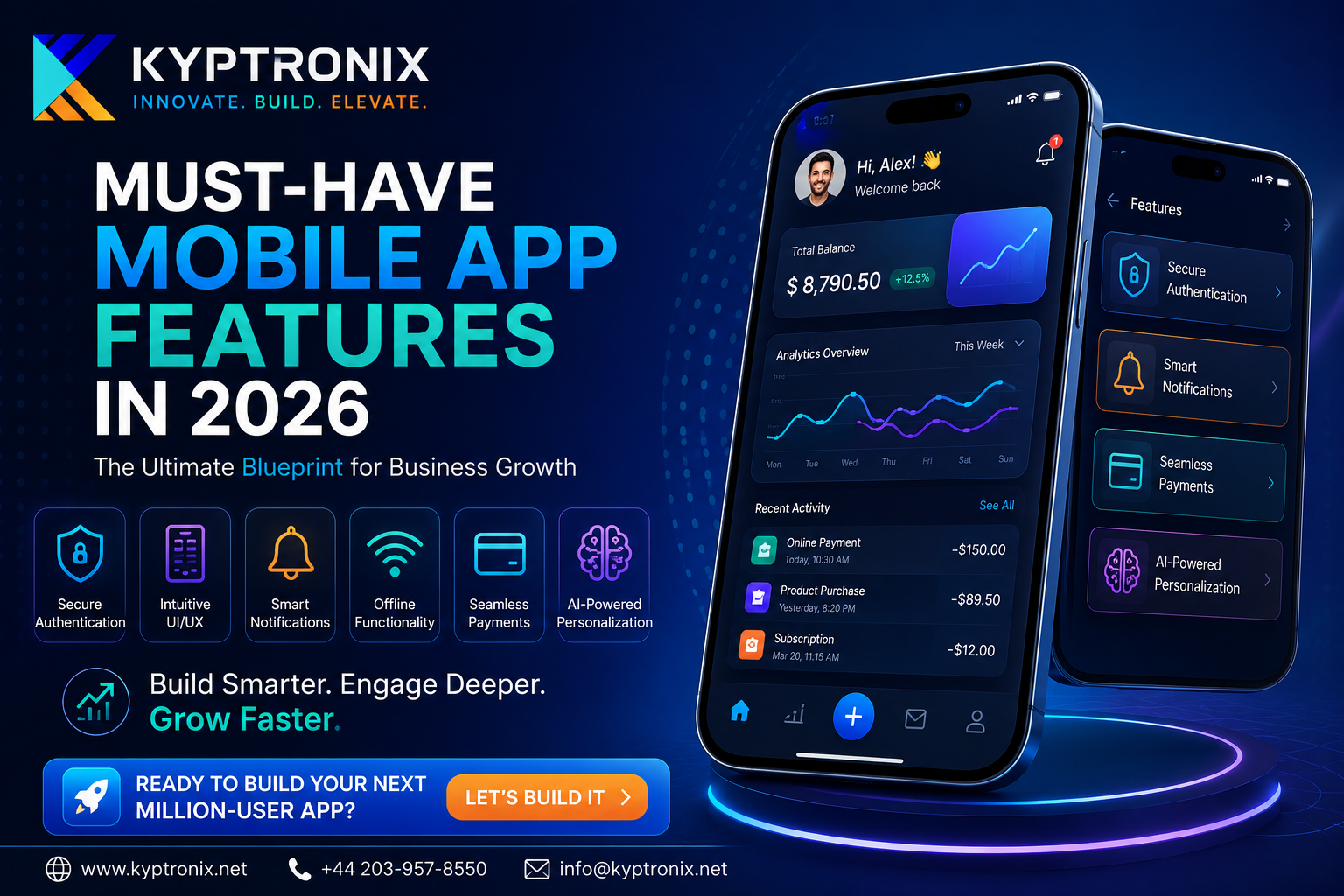
| Feature Classification | Core Purpose | Impact on User Experience & Retention | Technical Overhead |
|---|---|---|---|
| Secure User Authentication | Safely verifies user identity and protects account data | Reduces initial sign-up drop-off by up to 50% | Moderate (Requires OAuth 2.0 & biometric APIs) |
| Intuitive UI/UX Design | Provides clear, effortless visual navigation and layout | Slashes single-session app abandonments dramatically | High (Demands extensive prototyping & testing) |
| Behavioral Push Notifications | Delivers timely, personalized user nudges off-app | Drives Day 7 retention up to 12.4% when contextual | Low to Moderate (Requires smart segmentation logic) |
| Resilient Offline Functionality | Preserves core utility when internet connectivity drops | Eliminates crash frustration for the mobile workforce | High (Requires local caching & sync pipelines) |
| Seamless Payment Integration | Facilitates frictionless 1-click financial checkout | Directly increases conversion rates and average order value | Moderate (Requires PCI-DSS compliant gateways) |
| AI-Driven Personalization | Adapts content and workflows dynamically to user habits | Nearly doubles Day 30 retention from 5% to 9.1% | High (Requires predictive analytics & vector engines) |
Section 1: The 6 Non-Negotiable Core Features for Every Business App
Before you invest in exotic experimental technologies, your software foundation must be rock-solid. These six core Mobile App Features form the essential baseline of any enterprise-grade application.
1. Frictionless & Secure User Authentication
The first sixty seconds of a user's interaction dictate whether they stick around or abandon your app forever. Demanding that a new user fill out a ten-field registration form before seeing any value is the fastest way to kill your conversion funnel.
Modern business applications require streamlined user authentication that balances military-grade security with absolute ease of use:
- Passwordless Biometric Login: Integrating native Face ID and fingerprint scanning APIs enables returning users to log in instantly without needing to remember complex passwords.
- Social & Enterprise Single Sign-On (SSO): Allowing one-tap registration via Google, Apple ID, or corporate SAML/OAuth providers removes sign-up friction entirely.
- Progressive Disclosure: Collect profile details over time as the user explores the app, rather than forcing a heavy registration wall on the first screen.
2. High-Performance, Intuitive UI/UX Design
An app can possess sophisticated backend algorithms, but if navigating its menus feels confusing, users will walk away. Exceptional UI/UX design focuses on reducing cognitive load, making every action feel natural, predictable, and fast.
The 2-Second Rule: Industry studies confirm that if an app takes longer than 2 to 3 seconds to load a screen or process a user tap, the likelihood of immediate app uninstallation increases by over 50%.
Key design elements every business app must implement include:
- Thumb-Zone Layout: Position primary action buttons within easy physical reach of the user's thumb during one-handed smartphone use.
- Micro-Interactions: Provide subtle visual or haptic feedback, such as a light button vibration or smooth loading animation, so users know their action was registered.
- Accessibility Standards: Ensure high contrast ratios, dynamic font scaling, and voice-over screen reader support to accommodate all users seamlessly.
3. Contextual, Behavioral Push Notifications
Unfiltered, generic broadcast messages are viewed by users as mobile spam, which represents the single biggest trigger for app uninstalls. However, when used thoughtfully, push notifications are the single most effective tool for bringing dormant users back into your application.
Instead of blasting your entire database with generic promotional messages, modern notification engines leverage behavioral triggers:
- Transactional Alerts: Instant updates for order confirmations, delivery tracking, or security login attempts.
- Behavioral Nudges: Automated, personalized messages triggered by user actions, such as reminding a user about an abandoned shopping cart or suggesting a calendar event based on past routines.
- Preference Control Centers: Give users granular controls to select exactly which types of alerts they want to receive and how frequently.
4. Resilient Offline Functionality
Mobile network signals drop constantly, whether your user is riding an elevator, traveling through a tunnel, or working in a remote field location. An application that freezes or throws a blank error screen the moment internet connectivity drops feels unreliable.
Integrating robust offline functionality ensures your core software utility remains accessible regardless of network status:
- Local Data Caching: Store critical data assets, recent user history, and pending tasks directly on the device using lightweight local databases like SQLite or Realm.
- Background Sync Pipelines: Allow users to complete actions offline, such as writing a report, saving an item, or updating a task. Queue these actions locally and automatically sync them with cloud servers once a stable connection is restored.
5. High-Conversion, Seamless Payment Integration
If your mobile application involves financial transactions, whether it is an e-commerce checkout, a service booking, or a software subscription, your checkout flow must be completely effortless.
A modern seamless payment integration eliminates manual credit card entry:
- Native One-Tap Wallets: Full integration with Apple Pay, Google Pay, and localized digital wallet solutions.
- Automated Recurring Billing: Support for secure, tokenized subscription management for recurring service plans.
- Multi-Currency & Regional Compliance: Automatic localized currency display and compliance with regional financial security protocols, such as 3D Secure 2.0.
6. Enterprise Data Encryption & Zero-Trust Security
With data privacy regulations growing stricter worldwide, security is a vital pillar of customer trust. A single data breach can result in massive legal penalties and permanently ruin your brand reputation.
Essential security features include:
- End-to-End Data Encryption: Secure all data in transit using TLS 1.3 protocols and encrypt sensitive local device storage using AES-256 standards.
- Biometric Step-Up Authorization: Requires extra biometric authentication before allowing high-risk actions, such as changing account passwords or executing large financial transfers.
- Regulatory Compliance: Build workflows that align strictly with global standards such as GDPR, HIPAA for healthcare data, and PCI DSS for payment handling.
Section 2: The 4 Growth Engine Features That Boost Retention in 2026
Once your core functional layer is stable, you can layer on advanced Mobile App Features designed to turn occasional visitors into highly engaged daily users.
7. AI-Driven Personalization Engines
Generic, static app interfaces are rapidly becoming obsolete. Users expect software to adapt to their individual preferences, habits, and contexts quietly in the background.
Data from McKinsey and Sensor Tower reveal that applications incorporating AI-driven personalization experience a 37% lift in user engagement and can nearly double their 30-day app retention rate compared to static applications.
Ways to implement smart personalization:
- Dynamic Home Dashboards: Automatically surface relevant products, tools, or content based on the user's past actions and time of day.
- Predictive Search & Recommendations: Suggest search terms and products before the user finishes typing, powered by machine learning recommendation models.
8. Real-Time In-App Analytics & Telemetry
Building an application without embedded usage telemetry is like driving with your eyes closed. You cannot improve what you do not measure.
Integrating deep in-app analytics allows your product managers to observe real user behavior:
- Funnel Drop-Off Tracking: Identify the exact screen where users abandon registration or checkout flows.
- Behavioral Heatmaps: Visualize where users tap, scroll, or experience friction.
- Automated Crash Telemetry: Receive real-time technical reports detailing the exact device state and code line whenever an application crash occurs.
9. Native System & Hardware Integrations
A major advantage of a mobile app over a desktop web browser is its ability to interact directly with powerful on-device smartphone hardware.
High-impact hardware integrations include:
- Precision Geolocation Services: Power location-aware features such as store finders, live delivery maps, and localized push notifications.
- Advanced Camera & AR Capabilities: Enable rapid QR code scanning, visual document processing, or augmented reality product previews.
- Biometric & Health Sensor Sync: Tap into wearable device sensors for health tracking or real-time identity verification.
10. Community & In-App Gamification Mechanics
Humans are fundamentally social and motivated by progress. Adding light gamification mechanics creates subtle habit loops that keep users returning daily.
Effective engagement mechanics:
- Streak & Achievement Tracking: Reward users for completing consecutive daily actions, such as logging a workout, finishing a lesson, or checking a daily task.
- In-App Feedback Widgets: Allow users to submit feature requests or report bugs directly within the app interface, making them feel heard.
- Social Sharing & Referral Links: Make it effortless for users to share achievements or invite colleagues with deep-linked referral incentives.
Strategic Engineering: Cross-Platform vs. Native Feature Deployment
A major strategic question facing software leaders is how to build these features efficiently without inflating the production budget.
Choosing a modern cross-platform development approach using frameworks like Flutter or React Native allows your team to write a single, unified codebase that deploys across both iOS and Android simultaneously.
Build Core Foundation
2-3 Months WindowLock in essential user authentication, responsive UI/UX design, and secure, seamless payment integration. Ensure all customer data is protected by enterprise-grade data encryption.
Reliability & Analytics
1 Month WindowDeploy resilient offline functionality so core features work without internet. Embed comprehensive in-app analytics to track user funnel drop-offs from day one.
Growth Engines & AI
Post-Launch SprintsLeverage analytics data to roll out targeted push notifications and AI-driven personalization. Continuously refine features to boost your 30-day app retention rate.
By taking advantage of cross-platform development, businesses can deploy complex Mobile App Features to both major mobile operating systems in parallel, cutting initial production timelines and costs by 30% to 45% while maintaining native-grade performance.
Conclusion: Partnering for Digital Success
Building a market-leading mobile app requires far more than drafting a list of desirable capabilities. It demands balancing user experience, technical architecture, data security, and long-term business goals into a single cohesive product.
Prioritizing the right Mobile App Features, from frictionless user authentication and responsive UI/UX design to smart push notifications and AI-driven personalization, ensures your application delivers immediate value, keeps users engaged, and drives measurable revenue growth.
At Kyptronix, we help businesses transform complex product ideas into high-performing mobile applications. Our global team of expert product strategists, UI/UX designers, and mobile engineers specializes in building custom, enterprise-grade software tailored to your specific business requirements. Whether you are looking to launch an innovative cross-platform app or modernize an existing digital platform, we provide the technical expertise to bring your product to life safely and efficiently.
Ready to build a powerful mobile app that drives real business results? Connect with the product development experts at Kyptronix.net today to schedule your technical consultation.
Frequently Asked Questions (FAQs)
The absolute non-negotiable features include secure user authentication, intuitive UI/UX design, high-conversion seamless payment integration, enterprise data encryption, and contextual push notifications. These features form the baseline security, usability, and retention foundation of any commercial product.
AI-driven personalization dynamically adapts content, product recommendations, and interface layouts to match individual user habits. Industry data shows that applications utilizing smart personalization see up to a 37% boost in user engagement and nearly double their 30-day app retention rate.
Mobile internet connections drop unexpectedly in elevators, rural areas, or crowded venues. Providing local data caching and background sync through offline functionality ensures your app remains usable without freezing or showing error screens, preventing user frustration and uninstalls.
To avoid triggering uninstalls, avoid sending generic promotional blasts. Instead, use push notifications for timely, personalized, and action-oriented alerts, such as order tracking updates or custom behavioral reminders, and provide a preference center where users can choose their alert settings.
UI/UX design directly shapes how easy and enjoyable an app is to navigate. A clean, responsive layout with fast load times and intuitive navigation reduces cognitive friction, helping users accomplish their goals quickly and lowering single-session app abandonment rates.
Yes. Modern cross-platform development frameworks like Flutter and React Native provide robust native bridges, allowing developers to seamlessly access hardware features like GPS, biometric camera sensors, Bluetooth, and accelerometer tracking with native performance.
Your in-app analytics framework should track key performance indicators including Day 1, Day 7, and Day 30 app retention rates, conversion funnel drop-off points, average session duration, daily active users (DAU), and real-time technical crash logs.
Biometric user authentication leverages native smartphone hardware (Face ID or fingerprint scanners) to quickly verify identity. It eliminates the need for users to remember complex passwords while providing a secure, encrypted barrier against unauthorized account access.
The global average 30-day app retention rate across most categories sits between 4% and 5%. You can beat this benchmark by optimizing your onboarding flow, leveraging AI-driven personalization, maintaining fast screen load speeds, and delivering timely push notifications.
High-performing applications typically release minor updates and performance patches every 2 to 4 weeks. Regular updates help squash technical bugs, ensure ongoing compatibility with annual iOS and Android operating system upgrades, and introduce new features based on user feedback.