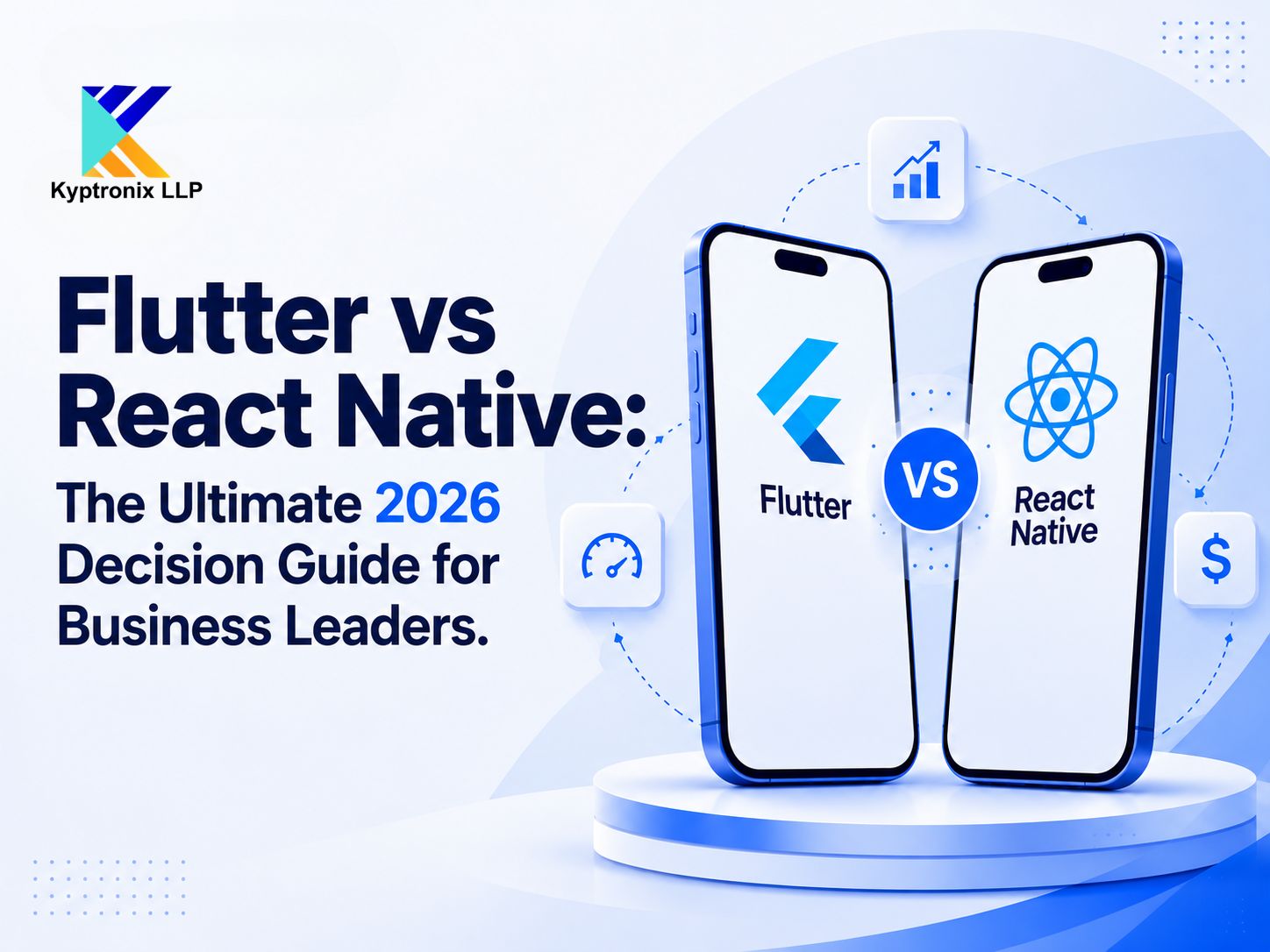
Flutter vs React Native: The Ultimate 2026 Decision Guide for Business Leaders
Imagine you are sitting across from your executive board, presenting a game-changing digital product strategy. The business model is validated, the marketing roadmap is locked in, and the funding is secured. Suddenly, your Chief Technology Officer leans forward and asks the definitive engineering question: “Are we building this on Flutter or React Native?”
If you have spent any time researching cross-platform mobile development, you know that this single choice will ripple through your entire corporate structure. It will dictate how quickly your engineers can push code updates, how much capital you spend on recruitment, how smoothly your software operates on a user's device, and how easily your product scales over the next five to ten years.
For years, selecting a mobile app development framework felt like a game of compromises. You either spent twice as much to build separate native iOS and Android apps, or you chose a shared code framework and prayed that your users wouldn't notice laggy animations or sluggish performance.
But as we cruise through 2026, those old software limitations are ancient history. The battle of Flutter vs React Native has evolved into a clash of two highly sophisticated, enterprise-grade engineering ecosystems. Today, both frameworks are fully capable of delivering breathtaking, high-performance apps that look and feel completely native.
The question is no longer about which framework is objectively “better.” Instead, it is about identifying the technical architecture that best aligns with your unique business constraints, existing development talent, and long-term product vision. Let us dive deep under the hood to find out.
The Core Contenders: A High-Level Snapshot
Before analyzing the underlying technical components, let us establish exactly who these two engineering giants are and see where they stand in the current technology landscape from the flowchart presented below.
1. The Flutter Ecosystem
Launched by Google, Flutter has rapidly matured into an incredibly powerful UI toolkit. Instead of attempting to bridge your code to native platform components, Flutter takes complete control of the screen. It treats the device display as a blank digital canvas and paints every single pixel from scratch using its own highly optimized graphics engine.
The Language Powering It: Flutter relies on the Dart programming language, a strongly typed, object-oriented language developed by Google. Dart features rapid Ahead-of-Time (AOT) compilation for production builds and Just-in-Time (JIT) compilation for lightning-fast development iterations.
Enterprise Champions: Globally trusted by massive brands like BMW, Alibaba, eBay, and Tencent.
2. The React Native Framework
Created by Meta, React Native completely revolutionized the software engineering landscape by bringing the immense power of web-based development to mobile devices. Instead of painting its own layout components, React Native allows developers to write familiar web code that dynamically binds to the actual, physical native user interface components of the host operating system.
The Language Powering It: Built entirely on JavaScript and TypeScript. Because it uses a popular JavaScript framework, it links directly to the largest web developer talent pool on earth.
Enterprise Champions: Power world-class digital platforms like Instagram, Shopify, Uber Eats, and Skype.
Architectural Comparison: Under the Hood in 2026
To understand how these platforms perform in the real world, we must examine how they communicate with a user's smartphone hardware. The internal architecture of Flutter vs React Native reveals two completely distinct philosophies on software design.
React Native's Modern Architecture (Fabric & JSI)
Historically, the biggest knock against React Native was its reliance on the “JavaScript Bridge.” Every time your app needed to update a view or process a user tap, it had to serialize that data into JSON, send it across a digital bridge, and deserialize it on the native side. This bridge created a noticeable bottleneck for complex animations or fast scrolling.
In the modern mobile landscape, that old bridge has been completely phased out. Meta has stabilized its New Architecture globally. The old bridge is replaced by the JavaScript Interface (JSI), which allows your JavaScript code to directly and synchronously invoke native C++ methods on the device. Paired with Fabric, a highly optimized, thread-safe concurrent rendering engine, React Native now achieves incredible responsiveness that matches native app performance for traditional business apps.
Flutter's Custom Rendering Strategy (Impeller)
Flutter takes a completely different path. It doesn't care about the host platform's built-in user interface components. Instead, it embeds its own highly efficient graphics rendering engine directly inside the app package.
Google has completely stabilized the Impeller graphics engine across both iOS and Android, replacing the legacy Skia framework. Impeller pre-compiles all visual graphics shaders directly during your initial build process, eliminating the frustrating first-run animation stutters that used to plague hybrid apps. By sending raw rendering commands straight to the device's GPU, Flutter achieves a fluid, rock-solid 120 frames-per-second performance profile out of the box.
Performance Evaluation: Speed, Fluidity, and Hardware Access
But how do these architectural choices play out when a real user downloads your application? Let us look at how both frameworks perform across critical operational categories:
Computational Efficiency and Memory Footprint
Because Flutter compiles your source code directly down to machine-level ARM and x86 binaries via the Dart programming language, it starts up incredibly fast and uses system memory very efficiently.
React Native, while vastly improved by the JSI architecture, still requires the device to launch a lightweight JavaScript engine runtime, such as Meta's Hermes engine, in the background to interpret your code. For standard enterprise apps, this minor architectural overhead is completely unnoticeable. However, if your application processes intense, heavy computing tasks, such as real-time audio filters, massive image rendering, or advanced mathematical calculations, Flutter's compiled architecture has a clear technical advantage.
Hardware Interface and Sensor Connectivity
Connecting your app to a phone's physical hardware, like Bluetooth beacons, biometrics, or GPS tracking, presents another interesting contrast:
- React Native's Approach: It relies heavily on its massive open-source ecosystem. If you need to integrate a custom camera view or a fingerprint scanner, there's a good chance that an active developer has already published a stable module for it.
- Flutter's Approach: It uses specialized platform channels to pass data down to native code. While highly reliable, writing custom native system extensions in Flutter can sometimes require your team to possess a deeper understanding of native iOS and Android environments.
UI/UX Flexibility and Design Consistency
Your application's interface is the digital storefront for your brand. When comparing Flutter vs React Native on design execution, your choice dictates how much control your designers retain over the final product.
The Pixel-Perfect Consistency of Flutter
Because Flutter controls every pixel on the screen via its own rendering engine, it delivers absolute visual consistency across all device types. An app running on a five-year-old budget Android phone will look the same down to the millimeter as the same app running on the latest flagship iPhone.
Flutter ships with a massive library of pre-packaged UI design elements, covering both Google's Material Design guidelines and Apple's Cupertino style sheets. This comprehensive kit makes Flutter the gold standard for projects that demand highly customized branding or complex, artistic interfaces that must remain completely uniform across the entire mobile landscape.
The Native Authenticity of React Native
React Native takes the exact opposite approach. Because it maps your code straight to native operating system widgets, your app automatically inherits the exact look, feel, and native behavioral patterns of the user's chosen smartphone.
When Apple updates its system fonts, text selection sliders, or button animations in a new iOS release, your React Native application instantly adopts those changes without requiring a full code rebuild. This organic integration gives React Native apps an authentic feel that blends seamlessly into the smartphone's operating system.
Business Metrics: Time to Market and Cost Efficiency
As a business leader, technical elegance is only half the puzzle. You must also evaluate how your technology stack directly impacts your operational balance sheet and your competitive delivery speed, as shown in the flowchart below:
Accelerating Your Time to Market
Both ecosystems offer an immense boost to your development speed compared to native builds. Features like “Hot Reload” allow your engineering team to modify source code and instantly view the visual results on test devices, without waiting for slow compilation cycles.
However, if your goal is to launch a polished prototype as fast as possible, Flutter's out-of-the-box UI design elements give it a slight edge. Your team can rapidly assemble beautiful, fully functional layouts without spending weeks writing custom styles or hunting for stable third-party user interface packages. This rapid development loop can significantly shorten your overall time to market for mobile apps.
Maximizing Recruitment and Development Capital
When it comes to building your engineering team and maximizing your app development cost efficiency, React Native holds a massive business advantage.
JavaScript and TypeScript are the undisputed languages of the modern web. If your organization already employs an internal team of web developers who are experts in React, you can smoothly transition those existing engineers into cross-platform mobile development within a matter of weeks. Conversely, finding senior developers who are already experts in Flutter and the Dart programming language can sometimes take longer and command a hiring premium in competitive talent markets.
Long-Term Maintenance and Stability
The true cost of owning a digital product is rarely incurred during the initial build phase. It accumulates during long-term app maintenance. Keeping your software secure, stable, and bug-free as operating systems evolve is vital to protecting your investment.
Upgrades and Framework Churn
The Stability of Flutter: Because Google controls both the Dart language and the Flutter rendering engine, the ecosystem is incredibly cohesive. Upgrading a Flutter app to a newer version of the framework is typically a clean, automated process with minimal breaking changes.
Component Management of React Native: React Native's strength is its massive, decentralized community ecosystem, which can sometimes turn into a challenge during major version upgrades. Because a typical React Native app relies on dozens of third-party open-source packages to handle basic tasks like navigation or file access, a major framework update can create a domino effect of broken dependencies that requires careful developer time to resolve.
Summary Matrix: Flutter vs React Native
To help summarize this deep architectural comparison, let us look at how both frameworks stack up side-by-side across key business and technical metrics in 2026:
| Evaluation Dimension | Flutter Framework | React Native Ecosystem |
|---|---|---|
| Primary Backing Organization | Meta (Facebook) | |
| Core Programming Language | Dart programming language | JavaScript / TypeScript (JavaScript framework) |
| Rendering Architecture | Custom GPU rendering via Impeller engine | Dynamic mapping to platform native widgets |
| Visual Design Consistency | Flawless, identical across all operating systems | Adapts automatically to match host OS styles |
| Hiring & Talent Sourcing | Specialized talent pool (Growing rapidly) | Massive, highly accessible global talent pool |
| Ideal Use-Case Profile | Highly customized, brand-driven design apps | Data-driven, content-rich corporate apps |
The Decision Blueprint: Which Path Should You Choose?
Choosing the right platform comes down to mapping your specific project requirements against the unique technical strengths of each framework.
Your Business Should Choose Flutter If:
- You require a highly customized, brand-driven user interface that must look completely identical across every single smartphone configuration.
- Your product roadmap includes intensive graphical workloads, such as custom data visualizations, complex custom animations, or basic image manipulation features.
- You want to shorten your initial time to market for mobile apps by using a comprehensive, built-in toolkit of pre-designed components.
- You want to minimize long-term upgrade headaches with a single, highly cohesive framework controlled completely by Google.
Your Business Should Choose React Native If:
- Your company already employs a strong team of internal web engineers who are experts in React, JavaScript, or TypeScript.
- Your application relies heavily on displaying standard, data-driven content feeds, processing forms, and executing e-commerce transactions.
- You want your mobile application to feel like an organic extension of the user's phone, adapting automatically to system font and UI updates.
- You plan to share extensive blocks of business logic between your mobile applications and your desktop web dashboards to maximize app development cost efficiency.
Conclusion: Build Your Next Mobile Masterpiece with Kyptronix
In the debate of Flutter vs React Native, there is no single right answer. There is only one stack that perfectly matches your current business constraints and future scaling goals. Both tools represent the absolute pinnacle of modern cross-platform mobile development, and both are fully capable of powering market-leading products when managed by an expert team.
The secret to preventing unexpected delays and maximizing your return on investment is simple: partner with a technology consultant who values strategic planning, deep technical knowledge, and honest communication from day one.
At Kyptronix, we cut through the technical hype. We don't believe in a one-size-fits-all approach to engineering. Our experienced global team of product managers, UI/UX designers, and full-stack engineers has a proven track record of launching both elite Flutter platforms and high-performance React Native ecosystems. We take the time to analyze your unique feature requirements, evaluate your current team capabilities, and help you select and execute the ideal technology stack to drive real business growth.
Ready to stop debating and start building a mobile application your users will love? Connect with the product delivery specialists at Kyptronix.net today to schedule your comprehensive technical consultation.
Frequently Asked Questions (FAQs)
In raw processing tasks, Flutter holds a slight technical advantage because it compiles directly down to machine code without any runtime interpretation layers. However, thanks to React Native's modern JSI and Fabric rendering engine, the day-to-day performance difference for traditional business, e-commerce, and content applications is completely unnoticeable to the end-user.
React Native is generally much easier to source talent for globally. Because it runs on JavaScript and TypeScript, you can tap into the massive world of web development talent. Sourcing engineers who are highly proficient in Flutter and the Dart programming language typically requires a more targeted search.
Yes, cross-platform apps carry a slightly larger initial download footprint than purely native apps. A simple Flutter app must bundle its own rendering engine, while a React Native app bundles its own JavaScript runtime. This typically adds about 5 MB to 10 MB of overhead, which is negligible on modern smartphones.
No. There are no automated translation tools capable of converting React Native code into Flutter syntax. Because their core languages (JavaScript vs. Dart) and underlying architectures are completely different, migrating from one to the other requires a full rewrite of the frontend interface; however, your backend APIs and server databases can remain completely intact.
Absolutely. Both frameworks are widely trusted by major financial institutions worldwide. Security depends entirely on how your software architects design your data-handling layers, such as by implementing strong end-to-end encryption, enforcing multi-factor authentication, and securing local device storage, rather than the framework itself.
Hot reload is a major development feature built into both frameworks. It allows developers to inject updated source code directly into a running app on a test device instantly, without recompiling the entire application. This speeds up bug fixing and design tuning, dramatically improving your team's development efficiency.
Flutter wins this category out of the box. It ships with an exhaustive, built-in library of Material and Cupertino widgets that let developers build beautiful, uniform layouts instantly. React Native provides fewer default styling blocks, preferring to let developers choose from a wide variety of third-party libraries or build custom styles from scratch.
Both frameworks handle offline workflows beautifully. Developers can integrate secure, lightweight local databases, such as SQLite, Hive, or Realm, to store data directly on the user's phone, allowing the app to run smoothly without an active internet connection and sync with cloud servers once connectivity returns.
Yes. Both frameworks support writing custom native modules. If your application requires a niche, low-level system feature that standard cross-platform libraries don't support, your developers can write native Swift or Kotlin code and connect it to your main application using platform bridges or channels.
For most standard commercial applications, the end-to-end timeline ranges between 4 and 7 months. This schedule provides ample time to complete initial discovery scoping, comprehensive UI/UX layout design, full-stack engineering sprints, and rigorous cross-device quality assurance testing before launching to the app stores.